

Why Your Feet Hurt After Hunting — And What to Do About It

You made it out. Miles of mountain behind you, pack on your back, the kind of tired that only comes from hunting hard. But now you're back at camp — or back home — and your feet are wrecked. Heel pain. Arch burning. Toes that screamed the last two miles in.
Most hunters tell themselves the same thing: that's just part of it. Push hard, your feet pay the price. Next season you'll break the boots in better. Buy thicker socks. Tape up before you go.
Here's what nobody tells you: foot pain after hunting isn't a badge of honor. It's a structural problem with a structural solution. Left unaddressed, it gets worse — season after season — until a real injury pulls you from the field entirely.
This article breaks down exactly why your feet hurt after hunting, and what actually works to fix it permanently.
“Man these things really work. My right heel pain was getting pretty bad. Have done several weighted hikes with no pain. I put them in my everyday shoes as well. I’m on my feet all day most days. No discomfort.”
— Verified SheepFeet Customer
What Actually Causes Foot Pain After Hunting?
Most hunters assume it's the miles — or the weight, or just 'bad feet.' But the real causes are more specific, and more fixable, than that. Here are the six most common culprits:
1. Plantar Fasciitis — The Most Common Offender
The plantar fascia is the thick band of connective tissue running along the bottom of your foot, connecting your heel to your toes. When it's overloaded — from miles of uneven terrain, heavy packs, and inadequate arch support — it gets inflamed. The result: sharp heel pain, worst with your first steps in the morning, that eases as you warm up but returns hard on steep descents.
Plantar fasciitis is the single most common foot injury in hunters. The dangerous part: it builds slowly. You may not notice it until it stops you mid-pack-out.
🔗 Got Plantar Fasciitis Pain? Step Toward Relief with Custom Orthotics
2. Arch Collapse Under Load
Your arches are your body's natural shock absorbers. Most hunting boots ship with flat, generic insoles that offer minimal real arch support. After miles of carrying weight on uneven, off-trail terrain, those arches fatigue and begin to collapse. When the arch drops, everything downstream shifts — ankles, knees, hips, and lower back all compensate. The foot pain is your first warning. The joint damage comes next if you ignore it.
3. The Wrong Boot Fit (Even Expensive Boots Can Fail You)
You can spend $500 on premium hunting boots and still be set up wrong. Factory insoles are designed for a statistical average foot — manufactured to a cost target, shaped to fit the boot, not your specific arch height, heel width, and gait. If your foot's biomechanics don't match the generic shape of that footbed, you'll get hot spots, pressure points, and fatigue no matter how much the boots cost.
4. Blister-Driven Gait Changes
This one is sneaky. A blister forms on your heel or ball of foot, and you unconsciously shift your stride to protect it. That compensated gait loads your foot — and your entire leg — in ways it wasn't built for. What started as a blister becomes arch pain, ankle soreness, or knee strain by the end of the day.
5. Accumulated Load on Pack-Outs
Most foot problems on a hunt don't peak on day one — they compound. Every day, you're loading the same structures over and over with less recovery between sessions than your training hikes allowed. Add 60–80 lbs of elk quarter on top of already-fatigued arches and you've built a recipe for real damage. Pack-out foot pain is one of the most preventable injuries in the backcountry — but only if the right support was in place before you hit the trailhead.
🔗 Don’t Let Sore Feet Ruin Another Hunt: 3 Tips for All-Day Comfort
6. Boot Break-In vs. Foot Break-Down
There's a critical difference between a boot that's breaking in — softening and conforming over time — and a foot that's breaking down under inadequate support. Most hunters confuse the two. By the time the boot feels comfortable, the structural damage may already be done.

The difference between a boot breaking in and a foot breaking down is the most costly mistake hunters make.
Stop Hunting Through the Pain
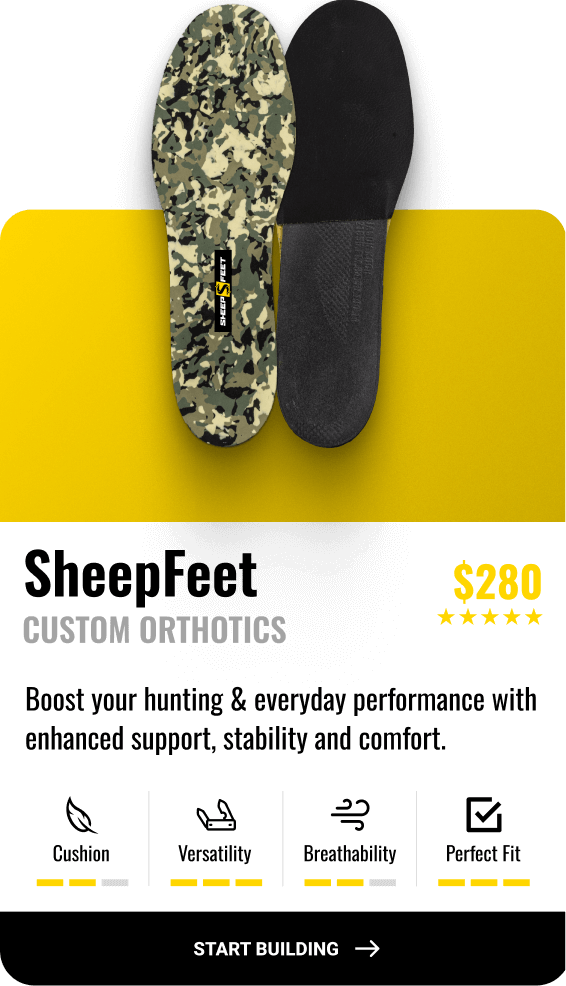
SheepFeet custom orthotics are built for hunters — fitted to your foot, designed for your boots, field-tested in mountain terrain.
SHOP SHEEPFEET CUSTOM ORTHOTICS →Why Generic Insoles Don't Solve the Problem
The insole that shipped inside your hunting boot was not designed for you. It was designed for a statistical average of feet, manufactured to a cost target, and shaped to fit the boot — not to support your specific arch height, heel width, and gait pattern.
Off-the-shelf insoles from the sporting goods store are marginally better, but they follow the same model: one shape, sold in sizes, designed to be acceptable for as many people as possible. 'Acceptable' is not what you need at mile 14 on a steep descent with 70 lbs on your back.
The fundamental problem is that foot pain is caused by structural mismatch — your unique foot pressing against a support that wasn't built for it. No generic product can solve a structural mismatch. That's not a criticism of those products. It's just physics.
“This is the 3rd pair of SheepFeet for me. Not because the other two wore out, but because I cannot live without them in different shoes and boots. I was sick of swapping them out all of the time. Game changing feet comfort.”
— Verified SheepFeet CustomerWhat Custom Orthotics Actually Do Differently
A custom orthotic starts with your foot — not an average foot. The fitting process captures the exact shape of your arch, the width of your heel, and the specific pressure points your foot creates under load. From there, a support structure is built to match what your foot actually is, not what the average foot looks like.
The practical difference on a hunt:
-
Sustained arch support: Your arch stays supported under load — even after 10 miles and 60 lbs on your back
-
Even load distribution: Pressure distributes evenly across the entire foot rather than concentrating on the heel or ball
-
Gait stabilization: Your gait stays consistent longer, reducing the compensatory strain on ankles, knees, and hips
-
Heel control on descents: The heel is held in its natural position on descents — exactly where most plantar fasciitis damage occurs
-
Reduced friction: Heat and friction reduce because your foot isn't sliding against an ill-fitting footbed all day
🔗 Step-by-step Guide To The Perfect Fit
What You Can Do Right Now
This Week: Reduce the Inflammation
-
Ice your heel and arch for 15–20 minutes after any weighted activity
-
Roll your foot over a frozen water bottle — 10 minutes in the morning and 10 minutes in the evening
-
Stretch your plantar fascia before getting out of bed: flex your foot, pull your toes back toward your shin, hold 30 seconds, repeat 3 times
-
Avoid walking barefoot on hard floors — every unprotected step reloads the inflamed tissue
Before Next Season: Fix the Root Cause
Stretching and icing are damage control. They manage the symptom, but they don't address the structural mismatch that's causing it. The only durable fix for foot pain caused by inadequate support is getting the right support in your boots — before you need it. Custom orthotics built specifically for your foot and your boots. Not a generic product off a shelf, not a heat-molded insert at a running store. A support system matched to your individual biomechanics.
Frequently Asked Questions
How do I know if my foot pain is plantar fasciitis or just normal soreness?
Plantar fasciitis has a signature pattern: sharp heel pain that is worst with your first steps in the morning or after sitting, that eases after 10–15 minutes of movement, and then returns after long periods on your feet. The pain is concentrated at the heel or inner arch — not diffuse across the whole foot. General muscle soreness improves consistently with rest and doesn't follow this morning-pain pattern. If you recognize the plantar fasciitis pattern, don't wait — it escalates.
Can I hunt with plantar fasciitis?
Many hunters do. But hunting through plantar fasciitis without addressing the underlying support issue risks escalating a manageable condition into a partial or full tear — an injury that can require months of recovery and potentially cost you a full season. The smarter play is to get proper support in place before the season, not after the injury forces your hand.
🔗 Got Plantar Fasciitis Pain? Step Toward Relief with Custom Orthotics
Will better hunting boots fix the problem?
A quality hunting boot matters — but it won't solve structural support problems on its own. The boot provides protection, traction, and waterproofing. The insole provides the biomechanical support that determines how your foot loads on every step. You need both working together. Upgrading the boot while keeping the generic factory insole is solving half the problem.
How long do custom orthotics last?
Quality custom orthotics typically last 3–5 years with regular use — significantly longer than generic insoles that compress and lose function within a single hunting season. Many hunters run multiple pairs across different boots at the same time rather than constantly swapping one pair. That's not a bug — it's what happens when something actually works.
Are custom orthotics only for people who already have injuries?
No — and waiting for an injury before getting proper support is the most expensive way to learn this lesson. Custom orthotics are preventive equipment, not just corrective. The hunters who benefit most are those who get fitted before their first serious pack-out season, not after they've already torched their plantar fascia.

Rest helps. The right support means you need less of it.
The Bottom Line
Foot pain after hunting is your body asking for better support. The causes — plantar fasciitis, arch collapse, gait compensation, accumulated load — are all addressable. But they require more than new socks or thicker tape. They require support that's built for your foot and the demands you put on it.
The hunters who stay in the field longest aren't the ones who push through the pain. They're the ones who eliminate the cause of the pain before it becomes a season-ending injury.
Your feet carry you to the animal and carry the meat home. They deserve better than a $12 generic insole.
Stop Hunting Through the Pain
SheepFeet custom orthotics are built for hunters — fitted to your foot, designed for your boots, field-tested in mountain terrain.
SHOP SHEEPFEET CUSTOM ORTHOTICS →

