

Work Boot Insoles: Custom Orthotics vs. Store-Bought — An Honest Breakdown for Tradespeople

Your buddy swears by his Superfeet. You’ve tried two pairs of Dr. Scholl’s and a $30 gel insert from the hardware store. Your feet still hurt by lunch.
Here’s the thing nobody in the insole aisle tells you: there’s a real difference between adding cushion and adding support. And for a roofer putting in 10-hour days on steep slopes, or a concrete finisher on their feet from 6 AM to 4 PM, that difference is the entire ballgame.
This is an honest, side-by-side breakdown of custom orthotics versus store-bought insoles for work boots — what each actually does, where each falls short, and how to know which one you actually need.
Best Insoles for Roofers and Construction Workers
The Problem with Your Current Insole
Most work boots ship with a flat foam footbed. It’s there to fill the boot, not to support your foot. After a week on the job site it’s already compressed flat and providing roughly the same structural support as a piece of cardboard.
Most tradespeople know this and upgrade. The question is what they upgrade to — and whether it actually solves the problem or just delays it.
The three most common complaints from tradespeople about insoles:
- They feel great for the first few hours, then my feet are killing me by the end of the shift. This is foam compression. OTC insoles are built on foam or cork that compresses under sustained load. By hour five or six, the arch support profile has flattened and you’re essentially back to a flat footbed.
- I’ve tried four different brands and none of them fixed my heel pain. If the heel pain is structural — meaning it’s coming from how your foot is loading — no OTC insole will fix it because OTC insoles aren’t built to your foot. They’re built to an average.
- My plantar fasciitis gets better when I’m off work, then comes back as soon as I go back. This is the clearest sign that the work environment is the problem. Rest lets the tissue heal; returning to the same unsupported footbed reloads it. The solution is structural, not more rest.
What Store-Bought Insoles Actually Do
Let’s be fair: a good OTC insole is a meaningful improvement over a flat factory footbed. Brands like Superfeet and Sof Sole provide real arch support, real heel cushioning, and real shock absorption that the factory insert doesn’t.
For tradespeople with mild foot fatigue and no specific structural issues, a quality OTC insole can be enough. But it has limits that matter at 10 hours a day, five days a week.
What OTC insoles do well:
- Add arch support above a flat footbed
- Absorb shock at heel strike
- Reduce early-shift foot fatigue
- Provide some heel stability
Where OTC insoles fall short for tradespeople:
- Built for a foot average, not your foot. Superfeet comes in low, medium, and high arch models. If your foot happens to match the shape of one of those models, you get decent support. If your arch height, heel width, or foot geometry falls outside the average — which is more common than you’d think — you’re getting partial support at best.
- Foam compresses under sustained load. A typical OTC foam insole is rated for 500 miles or 12 months. That sounds like a lot until you calculate 10 miles of walking per shift, five days a week. You’re through that insole’s effective life in about two months of full-time trades work. The insole doesn’t fall apart — it just quietly loses its support profile while still looking fine.
- No adjustments. If the arch support is in the wrong place for your foot, there’s nothing to adjust. You either buy a different model or accept the mismatch.
“Tried every kind of insoles out there — these are the only ones to work with my feet. I stand on concrete floors all day at work then use them for hiking and hunting all the time. Definitely worth the money!”
— Thomas G., Verified SheepFeet CustomerWhat Custom Orthotics Actually Do Differently
A custom orthotic isn’t just a better version of a store-bought insole. It’s a different category of product built on a different premise: your foot is specific, and your support should be too.
Here’s what changes when an insole is built from a scan or mold of your exact foot:
- Arch support at your exact arch height. Not a high, medium, or low model. The arch support sits exactly where your arch sits — which means your plantar fascia isn’t bearing the load that the insole should be taking.
- A heel cup built to your heel geometry. Factory and OTC heel cups are a generic shape. A custom heel cup wraps your specific heel, locks it in place, and prevents the inward roll that causes knee, hip, and lower back pain downstream.
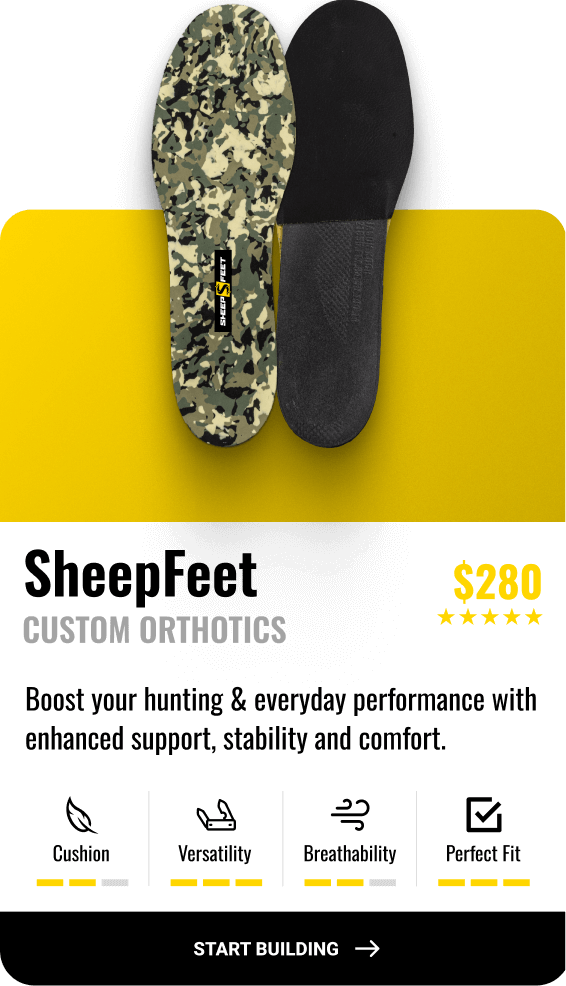
- Rigid shell holds shape under load. SheepFeet orthotics use a rigid or semi-rigid shell underneath a top cover. That shell doesn’t compress. Hour one and hour ten feel the same because the support structure hasn’t changed — your foot is still being held in the same position.
- Moves between boots. Your custom orthotics go with you. Same pair in your work boots Monday, your hiking boots on the weekend, your casual shoes on your off day. Consistent support across everything you wear.

Side-by-Side: Custom Orthotics vs. OTC Insoles for Work Boots
|
SheepFeet Custom |
OTC Insole (e.g. Superfeet) |
|
|
Fit |
Your exact arch + heel geometry |
Population average |
|
Support structure |
Rigid/semi-rigid shell — holds shape all day |
Foam — compresses after 4–6 hrs |
|
Heel control |
Custom heel cup, locks your heel in |
Generic heel cup — varies by brand |
|
Lifespan |
3–7 years |
6–12 months |
|
Cost per year |
~$40–$95/yr amortized |
$50–$70/yr replaced annually |
|
Boot compatibility |
Any work boot — full & 3/4 length options |
Most boots — trim to fit |
|
HSA/FSA eligible |
Yes |
No |
|
Adjustments |
Free until it’s right |
N/A — buy another pair |
The Real Cost Comparison
The price of custom orthotics is the first thing tradespeople push back on. Here’s what the math actually looks like over time:
- OTC insoles: A quality pair of Superfeet runs $55–$70. For a full-time tradesperson, effective life on a job site is roughly 2–3 months of heavy use before the arch support profile has compressed. At $65 replaced three to four times a year, you’re spending $195–$260 per year on insoles that still leave you with foot pain.
- SheepFeet custom orthotics: SheepFeet orthotics are built to last 3–7 years. Amortized over five years, the annual cost is $40–$95 per year — comparable to or below what most tradespeople are already spending on OTC insoles that don’t fully solve the problem.
That math doesn’t account for the cost of foot pain: the days worked through pain, the knee and hip strain from compensating, or the productivity hit from being on your feet for 10 hours when your feet are wrecked.
The SheepFeet Difference: 70+ Years of Foot Science
SheepFeet isn’t a startup that decided to sell insoles. Caleb Bowen’s grandfather was a podiatrist. His father studied biomechanics at the School of Podiatric Medicine in Chicago, taught orthotics manufacturing to podiatrists across the country, and spent over 40 years running a commercial orthotics lab that built custom orthotics for doctors and clinics nationwide. Every pair goes through 225 hand-touch processes. Everything is still made in the USA.
The fitting process takes less than 10 minutes. Using the SheepFeet app on an iPhone, you scan your feet with CastDAR technology — a 3D scan that captures your exact arch height, heel geometry, and foot dimensions. No doctor’s office. No waiting room. If you don’t have an iPhone, the Impression Kit ships to you and you mail back your foot molds.
Free adjustments until they’re right. Full refund if they’re not. HSA and FSA eligible.
How the SheepFeet Fitting Process Works
Your Feet Take the Hit So Your Work Doesn’t Have To.
SheepFeet custom orthotics are built to your exact foot — fitted in under 10 minutes, made in the USA, HSA/FSA eligible.
SHOP SHEEPFEET CUSTOM ORTHOTICS →
How to Know Which One You Actually Need
Not everyone needs custom orthotics. Here’s an honest guide:
OTC insoles are probably enough if:
- You’re working part-time or light-duty on your feet
- You have no specific foot issues and your arches match a standard model
- You’re looking for a basic upgrade over a flat factory footbed
- Budget is the primary constraint and the pain is minor
Custom orthotics are the right call if:
- You’re on your feet 8–12 hours a day, five or more days a week
- You’ve already tried multiple OTC insoles and still have foot pain by end of shift
- You have plantar fasciitis, heel pain, or recurring arch pain that doesn’t resolve
- Your foot pain is affecting your work quality, pace, or mood on the job
- You want a solution that lasts years instead of months
“If you’re on the fence about making this investment on yourself, jump right into a pair of SheepFeet! Why? Because your feet are worth it!”
— Rudy V., Verified SheepFeet CustomerFrequently Asked Questions
Are custom orthotics worth it for construction workers and roofers?
Yes — for tradespeople who spend 8–12 hours a day on concrete, hard floors, or uneven job site terrain, custom orthotics are worth the investment. OTC insoles are built for a population average and compress under sustained heavy load. Custom orthotics built on a rigid shell hold their support structure all day, fitted to your exact foot geometry. For tradespeople dealing with recurring foot pain or plantar fasciitis, custom orthotics typically break the cycle that OTC insoles only slow.
How long do custom orthotics last in work boots?
SheepFeet custom orthotics typically last 3–7 years with regular daily use in work boots. For a full-time tradesperson replacing OTC insoles every 2–3 months, the amortized annual cost of SheepFeet ($40–$95/yr) is comparable to or lower than the annual OTC replacement cost ($195–$260/yr).
Will SheepFeet custom orthotics fit in steel-toe work boots?
Yes. SheepFeet offers both full-length and 3/4-length orthotics. The 3/4-length option is specifically designed for work boots with lower volume and steel or composite toes. If you’re unsure which fits your specific boot, the SheepFeet team will help you choose before you order.
What’s the difference between custom orthotics and OTC insoles for work boots?
The core difference is fit precision and structural durability. OTC insoles are built to a population average across a few arch height models. Custom orthotics are built from a 3D scan of your exact foot. Under 10 hours of sustained load on hard surfaces, OTC foam compresses and loses its arch support profile. A custom orthotic’s rigid shell holds its support geometry through the full shift.
Can I use the same SheepFeet orthotics in multiple pairs of work boots?
Yes. SheepFeet orthotics are designed to move between footwear. Many tradespeople swap them between their work boots, hiking boots, and casual shoes so their feet get consistent structural support regardless of what they’re wearing.
Are SheepFeet orthotics HSA or FSA eligible?
Yes. SheepFeet custom orthotics are HSA and FSA eligible, meaning you can use pre-tax dollars to purchase them, which effectively reduces the out-of-pocket cost significantly.
The Bottom Line
Store-bought insoles are not the same product as custom orthotics. One is a mass-produced foam insert sized to a population average. The other is a rigid-shell support structure built to your specific foot. Under the demands of a full-time trades job — concrete, steep slopes, steel-toed boots, 10-hour days — that difference is felt by end of shift every single day.
If your feet are limiting your work, your pace, or your quality of life after the shift, you’re not dealing with a cushion problem. You’re dealing with a support problem. And support problems have support solutions.
Stop Replacing Insoles That Don’t Work.
One fitting. Built to your foot. Lasts years. Free adjustments. HSA/FSA eligible.
SHOP SHEEPFEET CUSTOM ORTHOTICS →

