

Custom Orthotics vs. Stock Insoles: An Honest Comparison for Hunters

Let's be direct about the question you're actually asking: is it worth spending $280 on custom orthotics when you can grab a pair of Superfeet for $55, or a drugstore insert for $12?
It's a fair question. And the honest answer depends entirely on what you're asking your feet to do.
If you're walking the dog and standing in line at the grocery store, a $12 insert might genuinely be enough. But if you're covering 10–15 miles a day on uneven mountain terrain, carrying 60+ lbs on a pack-out, and asking your feet to perform for 7 consecutive days — the math on that comparison changes completely. This article gives you the real numbers and a straight verdict so you can make an informed decision.
🔗 Plantar Fasciitis and Hunting: What Every Hunter Needs to Know
What You're Actually Comparing
Before the head-to-head, it helps to understand what these products fundamentally are — because they're not just different price points of the same thing.
Factory Insoles (Included with Your Boots)
The insole that ships inside your hunting boot is an afterthought. It's manufactured to a cost target, designed to fill space and provide a basic layer between your foot and the boot's interior, and shaped to fit the boot — not your foot. Most serious hunters remove them within a season. They provide minimal arch support, compress quickly under load, and offer no meaningful biomechanical correction.
Over-the-Counter Insoles (Superfeet, Powerstep, Dr. Scholl's)
OTC insoles are a meaningful upgrade over factory insoles. Brands like Superfeet use a structured shell with a deep heel cup and modest arch support. They are designed for a population average — specifically, the average arch height of a large sample of feet. For hunters whose arch height and foot shape happen to fall near that average, they can work reasonably well. For everyone else, the fit is a compromise.
Custom Orthotics (SheepFeet)
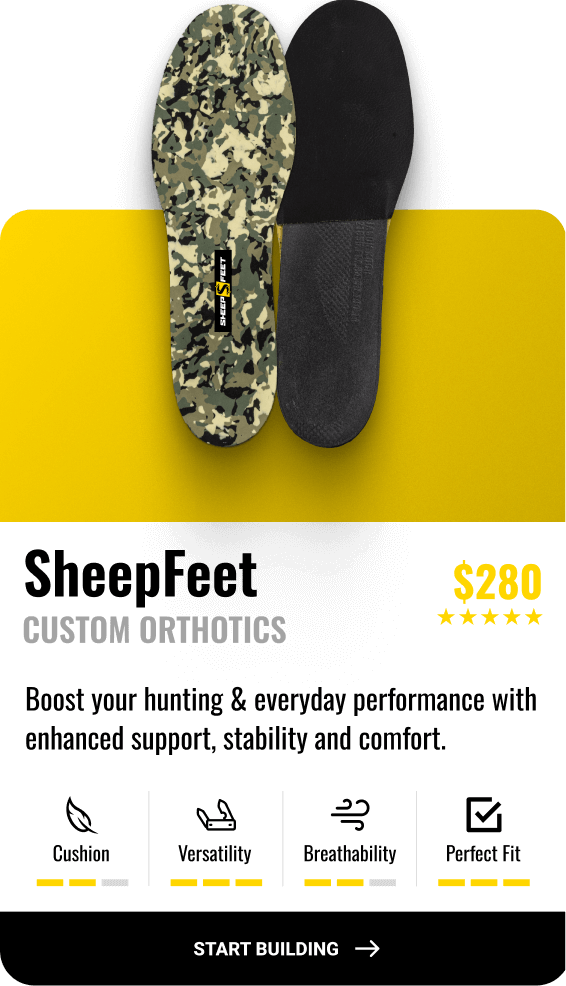
Custom orthotics start with a scan or mold of your specific foot — your arch height, your heel width, your pressure distribution, your gait mechanics. The support structure is then built to match what your foot actually is, not a statistical approximation. For hunters, SheepFeet's custom orthotics are also designed around the specific demands of mountain terrain: steep descents, heavy packs, and multi-day consecutive loading.
Head-to-Head: 8 Categories That Matter for Hunters
Let's run through the comparison across the eight factors that actually determine performance in the field.
|
Category |
Generic / OTC |
SheepFeet Custom |
Winner |
|---|---|---|---|
|
Arch Fit |
Average population fit — works well if your arch matches |
Built to your exact arch height and shape |
✓ SheepFeet |
|
Heel Control |
Basic heel cup — minimal lateral stability |
Deep custom heel seat — locks heel in neutral position |
✓ SheepFeet |
|
Pack-Out Load |
Support degrades after a few miles under heavy load |
Structured shell holds shape across multi-day loading |
✓ SheepFeet |
|
Break-In Time |
Some break-in required (1–2 wears) |
Ready immediately — fit is correct from day one |
✓ SheepFeet |
|
Lifespan |
1–2 seasons before meaningful compression |
3–5 years with regular field use |
✓ SheepFeet |
|
Boot Compatibility |
Fits most boots — may require trimming |
Fitted to your specific boots at time of order |
✓ SheepFeet |
|
Initial Cost |
$12–$55 |
$280 |
✓ Generic |
|
Cost Per Season |
$12–$55/year (replaces annually) |
$56–$93/year (amortized over 3–5 seasons) |
✓ SheepFeet |

SheepFeet custom. Better results.
The Real Cost Math: What You Actually Pay Per Season
The sticker price comparison is the wrong comparison. The right comparison is cost per season of effective use — because an insole that fails after six months isn't cheaper than one that lasts five years. It's just a different payment schedule.
Generic Insole Cost Over 5 Seasons
|
Superfeet Green (most popular hunting option): $55 Replace every season (they compress and lose function): × 5 seasons Total 5-season cost: $275 Drugstore insert option: $12 Replace every 4–6 months (often mid-season): × 10 replacements Total 5-season cost: $120 |
SheepFeet Custom Orthotic Cost Over 5 Seasons
|
SheepFeet custom orthotics (one-time): $280 Lifespan with regular hunting use: 3–5 seasons Cost per season (5-season lifespan): $56/season Cost per season (3-season lifespan, conservative): $93/season vs. Superfeet per season: $55/season Difference at worst case: $38/season more than Superfeet |
At worst, SheepFeet costs $38 more per season than Superfeet. At best — if they last 5 seasons, as many customers report — they cost almost exactly the same per season. And they're built for your foot, not the average foot.
The question stops being 'can I afford custom orthotics' and becomes: 'is $38 per season worth having support that's actually fitted to my foot?' For most hunters who've dealt with plantar fasciitis, blown a pack-out, or limped through the last two days of an elk hunt — the answer is obvious.
The Performance Gap Generic Insoles Can't Close
Cost aside, there is a category of performance difference that no over-the-counter product can bridge — not through better materials, not through a higher price point. It's the difference between a support structure built for average feet and one built for yours.
The Arch Height Problem
Arch height varies significantly between individuals. Superfeet offers several models with different arch profiles — Green (high arch), Blue (medium), Orange (high support) — but they're still working from population averages. If your arch height doesn't match the model you bought, you're wearing a compromised fit regardless of the quality of the product. A custom orthotic eliminates this variable entirely.
The Heel Seat Geometry
The heel seat — the cupped area that holds your heel in position — is one of the most critical elements of an insole for mountain hunting. On steep descents, the heel needs to be held in neutral to prevent the inward roll (overpronation) that strains the plantar fascia and loads the knee. Generic insoles use a standard heel cup geometry. Custom orthotics are shaped to your specific heel, which means the heel is actually seated correctly — not approximately.
Load Distribution Across Terrain
On flat terrain, the difference between generic and custom support is noticeable but manageable. On a 12% grade descent with 70 lbs of meat on your pack, that difference becomes the margin between making it to the truck and not. Custom orthotics distribute load across the full foot in proportion to your specific pressure map. Generic insoles redistribute load across an average pressure map. On easy terrain the gap is small. Under hunting conditions, it compounds.
|
Built for Your Foot. Built for the Mountain. SheepFeet custom orthotics are fitted to your exact foot — not an average. $280, built to last 3–5 seasons in the field. |
When Generic Insoles Are the Right Choice
This article would not be honest if it didn't acknowledge the cases where a generic insole is genuinely the better call.
-
You are a casual weekend hunter who averages 3–5 miles per day on easy terrain with no significant pack weight. The biomechanical demands don't justify the investment.
-
You have already been fitted for custom orthotics and need a backup pair for a second set of boots while your primary pair is in another. A quality OTC insole as a backup is reasonable.
-
You are a youth hunter still growing. Custom orthotics fitted to a foot that will change size in 12 months are not a sound investment — wait until foot size is stable.
-
Your budget is genuinely constrained right now. A good OTC insole is meaningfully better than a factory insole. Superfeet Green is a solid choice and far better than nothing.
For anyone else — serious hunters covering serious miles, anyone with a history of plantar fasciitis, anyone who has ever cut a hunt short because their feet gave out — the custom orthotic is the correct investment.
What About Heat-Molded Insoles?
Heat-moldable insoles — the kind you bake in an oven and then stand on to create a custom shape — occupy a middle ground that's worth addressing directly, because they're often marketed as 'custom' when they aren't.
Heat-molded insoles conform to the surface shape of your foot in a standing position. This is better than a static generic shape, but it has a critical limitation: standing-position mold captures your arch in a loaded, partially collapsed state — not its correct biomechanical position. You're essentially making a custom impression of your foot's compensated posture, then supporting it there.
True custom orthotics capture your foot in its neutral subtalar position — the mechanically correct alignment — and build support to hold it there. This is the difference between supporting a bad habit and correcting it.
For light use, heat-molded insoles are a legitimate upgrade over generic. For hunters dealing with arch collapse, plantar fasciitis, or heavy pack use, the distinction matters.

Frequently Asked Questions
Are custom orthotics covered by insurance or HSA/FSA?
Custom orthotics prescribed by a podiatrist or physician are often covered by insurance or reimbursable through HSA/FSA accounts. SheepFeet orthotics are purchased direct — check with your HSA/FSA administrator about reimbursement eligibility, as policies vary. If you have a history of plantar fasciitis or foot injury, a doctor's note may help qualify the purchase.
How do I know if my arch is high, medium, or low?
The quickest test: wet the bottom of your foot and step on a piece of paper. A high arch leaves only the heel, ball, and toes — little to no midfoot. A flat arch leaves a nearly complete footprint. Medium falls between. But the more useful question is whether your current insole is actually supporting your arch under load — not just at rest. The only way to know that precisely is a proper fitting.
Can I use SheepFeet orthotics in multiple pairs of boots?
Yes — and many customers do exactly this. SheepFeet orthotics can typically be transferred between boots as long as the volume and last geometry are compatible. Some customers purchase two pairs to avoid swapping — which, at $56–$93 per season per pair, still compares favorably to replacing generic insoles annually across multiple boots.
How long does the SheepFeet fitting take?
The fitting process takes less than an hour. SheepFeet fits at hunting events and directly — check the event calendar for dates near you. The orthotics are then built to your foot scan and shipped to you.
What if SheepFeet orthotics don't work for my feet?
Because they're built to your specific foot from a precise scan, the fit is designed to be correct from day one — unlike generic insoles where you're hoping the product's average matches your foot. If you have specific questions about fit for a particular condition or boot type, reach out before ordering. The fitting process includes that conversation.
The Verdict
For casual, light-use hunting: a quality OTC insole like Superfeet Green is a reasonable choice and meaningfully better than a factory insole.
For any serious hunter: covering real miles, carrying real weight, dealing with any history of foot pain, or simply refusing to let their feet be the limiting factor on a hard-earned hunt — custom orthotics are the correct investment. At $56–$93 per season amortized, they are not significantly more expensive than Superfeet. They are, however, significantly better.
The hunters who consistently say their feet never become the problem on a hunt are almost universally running some form of custom arch support. That's not a coincidence. It's the structural difference between equipment built for your foot and equipment built for the average foot.
Your next hunt doesn't care about averages. Neither should your insoles.
Built for Your Foot. Built for the Mountain.
SheepFeet custom orthotics are fitted to your exact foot — not an average. $280, built to last 3–5 seasons in the field.
SHOP SHEEPFEET CUSTOM ORTHOTICS →


