

Plantar Fasciitis and Hunting: What Every Hunter Needs to Know

It starts as a little heel soreness after a long day. You stretch it out, shake it off, chalk it up to the miles. By mid-season it's sharp pain with every step off the truck. By the third day of a pack-out, it's the only thing you can think about.
Plantar fasciitis is the most common foot injury in hunters — and the most misunderstood. Most hunters either push through it until it becomes a serious tear, or they spend months treating the symptom while the actual cause goes unaddressed.
This article covers what plantar fasciitis actually is, why hunters are especially vulnerable to it, how to recognize it before it sidelines you, and — most importantly — how to fix the root cause so it stops coming back every season.
🔗 LINK: Why Your Feet Hurt After Hunting - And What To Do About It
“I am currently using them in a pair of running shoes that I wear everyday at work in a hospital. I love the support they provide combined with the shock absorption of the shoes. When turkey season rolls around this spring I will swap them in to my boots to cover some ground in the mountains. Great product.”
— Verified SheepFeet Customer, Hospital Worker & Turkey HunterWhat Is Plantar Fasciitis — And Why Do Hunters Get It?
The plantar fascia is a thick band of connective tissue that runs along the bottom of your foot, connecting your heel bone to the base of your toes. Its job is to support your arch and absorb the shock of each step. When that tissue is repeatedly overloaded without adequate recovery — which is exactly what happens on a multi-day hunt — it develops small micro-tears. Those tears inflame, and that inflammation is plantar fasciitis.
It's not a rare condition. It's not a sign of weak feet or poor fitness. It is a predictable mechanical failure that happens when the demand placed on the plantar fascia exceeds the support structure underneath it. Hunters create that mismatch in several specific ways:
-
Uneven mountain terrain: Miles on uneven terrain put far more lateral stress on the fascia than flat-ground walking does
-
Pack weight amplification: Every pound on your back multiplies the load on your foot — a 70 lb pack can triple the effective force through your heel on descents
-
Cold weather and early starts: Cold morning starts mean the fascia is tight and inelastic when you first load it — this is when micro-tears happen fastest
-
Inadequate arch support: Factory insoles in hunting boots are flat and generic — they leave your arch unsupported through 12+ hours of daily loading
-
No rest between sessions: You're on your feet for 10–16 hours a day with no meaningful off-loading — the tissue never fully recovers between sessions
How to Recognize It: The Warning Signs Hunters Miss
The diagnostic signature of plantar fasciitis is pain with the first steps in the morning. Not general foot soreness — sharp, localized heel pain that hits hardest when you first put weight on your foot after rest, then eases somewhat after 10–15 minutes of movement, then returns and worsens after long periods on your feet.
Most hunters miss the early warning signs because the pain follows a deceptive pattern — it actually gets a little better once you're moving, which makes it easy to rationalize as 'just warming up.' But the tissue is still damaged. You're just masking the pain with increased blood flow.
Early Stage — Easy to Ignore, Dangerous to Miss
-
Mild heel soreness first thing in the morning that fades within a few minutes
-
Tenderness at the bottom of the heel when you press on it with your thumb
-
Slight stiffness in the arch after sitting for extended periods
-
Foot feels 'tight' at the start of a hike, loosens up after a mile
Mid Stage — The Season Is Now at Risk
-
Morning heel pain that takes 20–30 minutes or more to ease
-
Sharp pain on the first step out of the tent or off the cot
-
Pain that returns strongly during the last hours of a long day in the field
-
Noticeable tenderness on the inner heel — painful to direct pressure
-
Compensation in your stride — you may not notice it, but others will
Late Stage — You Are Now at Risk of Missing the Season
-
Constant heel pain that doesn't ease with movement
-
Pain during normal walking, not just under field conditions
-
Swelling or bruising near the heel
-
Pain that radiates into the arch or up the Achilles
-
Any incident of sharp, sudden pain mid-stride — this can indicate a partial tear

The plantar fascia runs from your heel to your toes. Every step on uneven terrain loads it. Without support, it eventually fails.
Why Hunters Are at Higher Risk Than Most Athletes
Distance runners get plantar fasciitis. So do basketball players and nurses. But hunters face a specific combination of risk factors that most sports medicine literature doesn't account for — because most sports medicine literature isn't written for people doing what you're doing.
The Pack Weight Multiplier
A 70 lb pack doesn't just add 70 lbs of force to your feet. On a descent, the effective load through your heel can reach 3–4 times your pack weight due to the mechanics of deceleration on a downhill slope. Your plantar fascia is absorbing that force on every step — thousands of repetitions per day, across multiple days, with no true rest between them.
The Terrain Variable
Road running is repetitive stress in a predictable plane. Mountain hunting is repetitive stress in an unpredictable, constantly-shifting plane. Every step on uneven ground requires the plantar fascia to make micro-adjustments that it wouldn't make on a flat surface. That variance compounds the loading damage significantly.
The Boot Problem
Most hunting boots are designed for toughness and waterproofing — not biomechanical support. The factory insole is an afterthought. A stiff-shanked boot with a flat factory insole locks your foot into a rigid environment with no dynamic arch support — and after a few miles, your plantar fascia is doing all the support work that a proper insole would be doing instead.
The Recovery Gap
In a training context, athletes have rest days. On a 7-day elk hunt, there are no rest days. The plantar fascia is repeatedly loaded from dawn to dark without the overnight recovery it needs to heal micro-tears. Each day starts with slightly more cumulative damage than the day before. This is why plantar fasciitis can go from 'barely noticeable' on day two to 'can't put weight on it' by day five.
Don’t Let Plantar Fasciitis Own Your Season
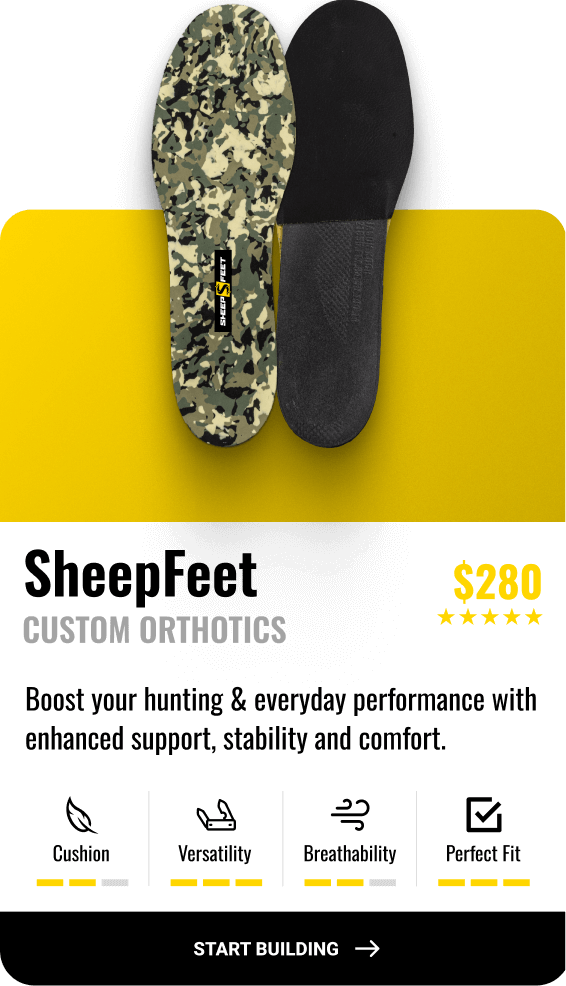
SheepFeet custom orthotics are built specifically for hunters — fitted to your foot, designed for your boots, field-tested on mountain terrain. Fix the root cause before season starts.
SHOP SHEEPFEET CUSTOM ORTHOTICS →What Actually Fixes It — And What Doesn't
Hunters are resourceful. By the time most of them find this article they've already tried a handful of things that didn't fully work. Here's an honest breakdown:
What Provides Temporary Relief But Doesn't Fix the Root Cause
-
Stretching — helpful for symptom management, does not address structural support deficit
-
Ibuprofen — reduces inflammation short-term, masks the pain signal that's telling you something is wrong
-
Heel cups and gel inserts — add cushion, which is not the same as adding support. Cushion compresses under load; support maintains structure
-
Rest alone — the fascia heals during rest, but returns to the same unsupported environment the moment you put your boots back on
-
Taping — valuable short-term field fix, but tape doesn't last and doesn't replicate true arch support
What Actually Addresses the Root Cause
The root cause of plantar fasciitis in hunters is structural: the plantar fascia is being asked to provide arch support that should be provided by the insole. The fix is to give it the support structure it's missing — specifically, a custom orthotic that matches your foot's exact arch height, heel shape, and pressure distribution.
Custom orthotics work differently than generic insoles in a specific way: they don't just add material under the foot, they hold the foot in its correct biomechanical position throughout the gait cycle. This means the plantar fascia is no longer doing the structural work it was never designed to do alone.
-
Arch support during loading: The arch is actively supported throughout the loading phase — not just at rest
-
Heel stabilization: The heel is stabilized, preventing the inward roll (overpronation) that strains the fascia insertion point
-
Full-foot load distribution: Load is distributed across the full foot rather than concentrated at the heel
-
Healing conditions created: The fascia can begin to heal because it's no longer being reloaded in a compromised position with every step
🔗 LINK: Support That Fits You: Why Your Feet Deserve The Right Choice
“I don’t mess around when it comes to my feet. Between long work days, time on the range, hiking, and training, if my feet aren’t right, nothing else is. The SheepFeet insoles are the real deal. Right out of the gate, the support is solid without feeling stiff or bulky. They lock your heel in, support the arch properly, and actually reduce fatigue instead of just adding cushion. That’s the difference. Cushion is soft—support is strength. These give you both. After long days on concrete and uneven ground, I’ve noticed way less foot soreness and less overall leg fatigue. Knees and lower back feel better too. That tells me everything I need to know.”
— Verified SheepFeet CustomerThe Hunter's Plantar Fasciitis Protocol
If You're in the Field Right Now
-
Tape your arch before putting boots on — figure-8 taping pattern from heel to mid-foot. YouTube 'plantar fasciitis taping' for a visual guide.
-
Take ibuprofen with food to reduce acute inflammation — don't mask pain to the point of ignoring a worsening tear.
-
Warm up before loading — 5 minutes of slow walking before ascending or carrying weight gives the fascia time to become more pliable.
-
Stretch first thing every morning before your first step — pull your toes toward your shin, hold 30 seconds, repeat 3 times before standing.
-
Ice your heel at camp every evening — 15 minutes on, 10 minutes off. A frozen water bottle works well.
-
Shorten your stride on descents — the heel strike on steep downhill is where the most fascia damage accumulates.
Before Next Season — The Permanent Fix
-
Get fitted for custom orthotics before the season starts — not after the injury forces your hand. The fitting takes less than an hour.
-
Begin a plantar fascia stretching routine 8 weeks before your first hunt — calf stretches, toe stretches, and rolling on a lacrosse ball daily.
-
Break in your boots with the orthotics already inside them — not with the factory insoles, then swapping later.
-
Do weighted training hikes with the same gear setup you'll hunt in — your feet need to adapt to that specific load before you're 6 miles from the truck.

The hunters who stay in the field longest are the ones who prepare their feet before the season, not after the injury.
Frequently Asked Questions
Can I hunt with plantar fasciitis without making it worse?
It depends on the stage. Early-stage plantar fasciitis can often be managed through a hunt with proper taping, anti-inflammatories, and careful pacing — but only if you're actively supporting the arch so the damage doesn't compound. Mid- or late-stage plantar fasciitis on a multi-day pack hunt without structural support is a risk you should take seriously. A partial fascia tear in the backcountry is a genuine emergency.
How long does it take for plantar fasciitis to heal?
Without addressing the root cause, plantar fasciitis can persist for 6–18 months — and frequently returns season after season. With proper arch support, targeted stretching, and reduced loading during recovery, most hunters see significant improvement within 6–12 weeks. The key variable is whether the structural cause is fixed or just the symptoms are managed.
Will a cortisone shot fix my plantar fasciitis?
Cortisone injections can reduce inflammation and provide significant short-term pain relief. They don't fix the structural mismatch that caused the inflammation. Most hunters who use cortisone without addressing the underlying support issue see the condition return within weeks to months. A shot can be a useful bridge — it's not a solution on its own.
Is plantar fasciitis the same as a heel spur?
Not exactly — though they often occur together. A heel spur is a calcium deposit that forms on the heel bone, sometimes as a result of chronic plantar fasciitis stress. Not everyone with plantar fasciitis has a heel spur, and not everyone with a heel spur has pain. The treatment approach for both focuses on reducing the mechanical stress on the heel — which is why proper arch support addresses both conditions.
Do SheepFeet orthotics work for plantar fasciitis specifically?
Yes — plantar fasciitis caused by structural mismatch (which is the majority of cases in hunters) responds directly to proper custom arch support. SheepFeet orthotics are fitted to your specific foot, not an average — which means the arch support is placed exactly where your arch needs it, not where the statistical average arch falls. For hunters who have struggled with recurring plantar fasciitis season after season, this is typically the intervention that breaks the cycle.
The Bottom Line
Plantar fasciitis doesn't have to be a recurring season tax. It's a predictable mechanical injury with a predictable mechanical fix. The hunters who break the cycle are the ones who stop managing the symptom and start addressing the structure.
After long days on concrete and uneven ground, after miles of mountain terrain, after pack-outs that would wreck most people — the difference between hunters who stay in the field and those who don't comes down to what's supporting their feet. That's not a figure of speech. It's biomechanics.
Get fitted before the season. Not after the injury.
Don’t Let Plantar Fasciitis Own Your Season
SheepFeet custom orthotics are built specifically for hunters — fitted to your foot, designed for your boots, field-tested on mountain terrain. Fix the root cause before season starts.
SHOP SHEEPFEET CUSTOM ORTHOTICS →


