

Foot Strength Exercises for Hunters: Train the Muscles That Actually Carry You

Most hunting fitness plans are built around the same three things: cardio, legs, and a heavy pack. Get your VO2 max up, squat heavy, do some stair climbs with weight on your back. All of that matters. None of it trains the part of your body that actually touches the mountain first.
Your feet and ankles are the interface between you and every loose rock, root, scree field, and steep descent you'll cross this season. If they're not trained specifically, they're the weak link — and weak links are exactly what end hunts. A rolled ankle on day two of a seven-day trip doesn't care how strong your quads are.
Why Foot and Ankle Strength Gets Skipped — And Why That's a Mistake
Foot and ankle muscles are small. They don't show up on a mirror, they don't get their own day at the gym, and most generic fitness plans never mention them by name. That's exactly why they're undertrained relative to how much work hunting actually demands of them.
Every step on uneven ground asks your foot and ankle to do something a flat gym floor never asks: react instantly to an unpredictable surface, stabilize your full body weight plus pack weight on a single point of contact, and absorb impact on a downhill step where your body weight is moving forward into the ground rather than just down onto it.
That's a different category of demand than walking on pavement or hiking a maintained trail. It's the specific reason hunters who are otherwise in great shape still roll an ankle, develop plantar fasciitis, or end up nursing Achilles pain by day four of an elk hunt.

The Exercises: Build Strength in the Three Areas That Matter
These exercises target the three systems that fail first on backcountry terrain: ankle stability, intrinsic foot strength, and calf/Achilles capacity. Start eight to twelve weeks out from your hunt. Three sessions a week, fifteen to twenty minutes each, is enough to build real change before opening day.
1. Ankle Stability
|
Single-Leg Balance: 3 sets of 30–60 seconds per side, 3x per week Stand on one foot on flat ground. Hold as long as you can with good form, working toward 60 seconds. Once that's easy, progress to an unstable surface — a folded towel, pillow, or balance pad. This trains your ankle's reactive stabilizers, the exact muscles that catch a rolling ankle before it becomes a sprain. Add arm movements (reaching up, down, side to side) once you've mastered the static hold. |
|
Resistance Band 4-Way Ankle: 2–3 sets of 12–15 reps in each direction, 3x per week Loop a resistance band around the ball of your foot. Perform plantar flexion (point toes down), dorsiflexion (pull toes up toward shin), inversion (pull foot inward), and eversion (push foot outward) against the band's resistance. This builds strength in all four planes of ankle movement — most hunters only ever train the up-and-down motion, leaving the side-to-side stabilizers (the ones that prevent a rolled ankle on a sidehill) completely undertrained. |
|
Step-Downs: 3 sets of 8–10 reps per leg, 2–3x per week Stand on a step or sturdy box. Slowly lower your opposite foot to the ground over a 4-second count, keeping your standing leg controlled and stable. This is the single most direct exercise for the deceleration control you need on steep, loaded descents — exactly the movement pattern of packing out an elk on a mountain trail. |
2. Intrinsic Foot Strength
|
Towel Scrunches: 2 sets of 10–15 reps per foot, daily Sit with a towel flat on the floor under your bare foot. Use only your toes to scrunch the towel toward you, then reset and repeat. This strengthens the small intrinsic muscles in your arch — the same muscles a custom orthotic supports, but exercise builds the strength while the orthotic provides the structural support during load-bearing activity. The two work together, not against each other. |
|
Toe Yoga: 2 sets of 10 reps per foot, daily Sitting or standing, lift only your big toe off the ground while keeping the other four flat. Reset, then lift only the other four toes while keeping the big toe down. This isolates control of the forefoot, which matters more than most hunters realize on technical, angled terrain where independent toe control affects your footing. |
3. Calf and Achilles Capacity
|
Calf Raises: 3 sets of 15–20 reps, 3x per week Stand near a wall for balance. Rise slowly onto your toes over 2 seconds, hold briefly, then lower over 4 seconds. The slow lowering phase is what builds tendon resilience, not just muscle strength. Progress to single-leg calf raises once double-leg feels easy — single-leg work translates much more directly to the uneven, one-foot-at-a-time loading of mountain terrain. |
|
Heel Drops (off a step): 3 sets of 12–15 reps, 3x per week Stand on a step with your heels hanging off the edge. Rise onto your toes, then lower your heels below the level of the step, getting a deep stretch through the calf and Achilles. This builds the eccentric strength your Achilles needs for repeated downhill loading — the movement pattern most directly linked to Achilles tendonitis in hunters who skip this kind of training. |

“I also felt more stable on uneven terrain in the mountains while elk hunting... I completely saw a difference!”
— ArcheryTalk Forum Member, Verified HunterPutting It Together: A Simple Weekly Routine
You don't need an hour a day. Here's a realistic structure that builds real strength before season without turning into another thing on your to-do list you abandon by week three:
-
Monday: Single-leg balance, resistance band 4-way ankle, calf raises (15 minutes)
-
Wednesday: Step-downs, towel scrunches, toe yoga (15 minutes)
-
Friday: Single-leg balance, heel drops, resistance band 4-way ankle (15 minutes)
-
Daily (anytime): Towel scrunches and toe yoga — these take under 5 minutes and build best with frequency
Start eight weeks before opening day if you're already reasonably active. Give yourself twelve weeks if foot and ankle strength has never been part of your training before. These muscles respond more slowly than your quads or glutes — don't expect overnight results, and don't skip the routine in week six because it feels like nothing is happening. The adaptation is happening at the tendon and stabilizer level, which takes longer to feel than it does to actually occur
Exercise Builds Strength. Support Protects It.
Here's the honest distinction: foot exercises build the strength and reactive stability your feet need on the mountain. They don't replace the structural arch support your foot needs while it's actually under load, carrying pack weight, mile after mile.
Think of it this way — exercise trains the muscles and tendons to do their job better. A custom orthotic makes sure your arch isn't collapsing or your heel isn't rolling while those muscles are working. They solve different problems, and hunters who do both get the most out of either one.
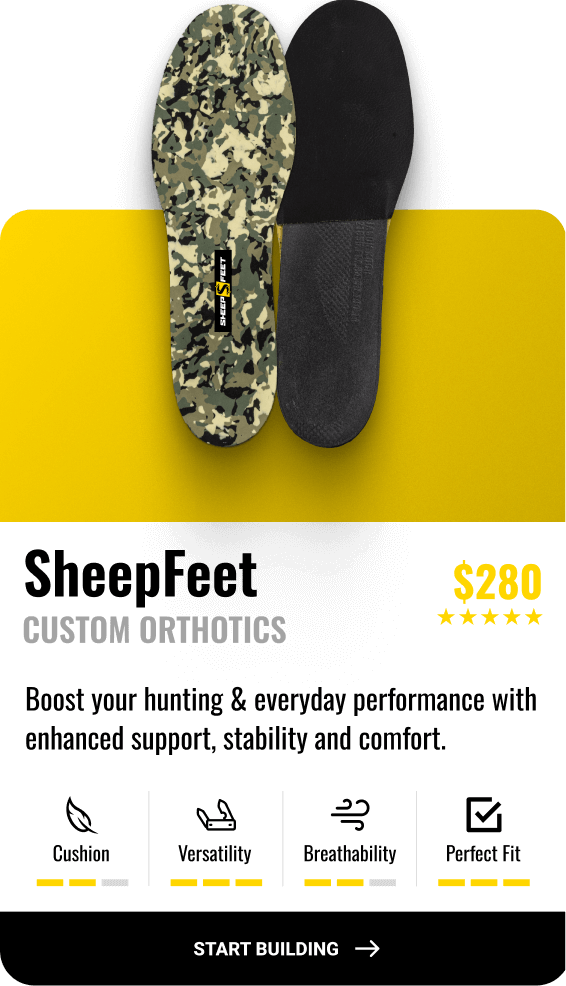
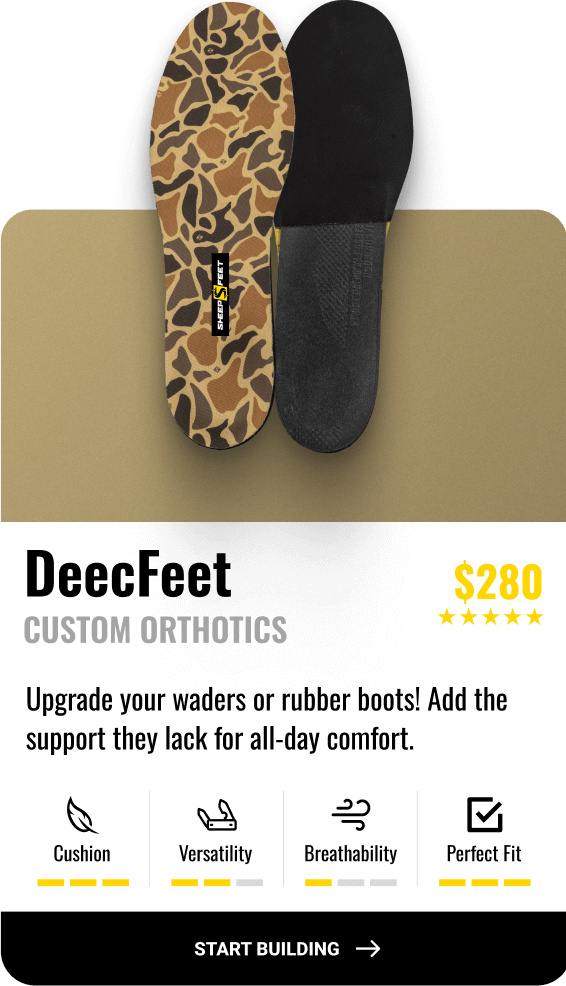
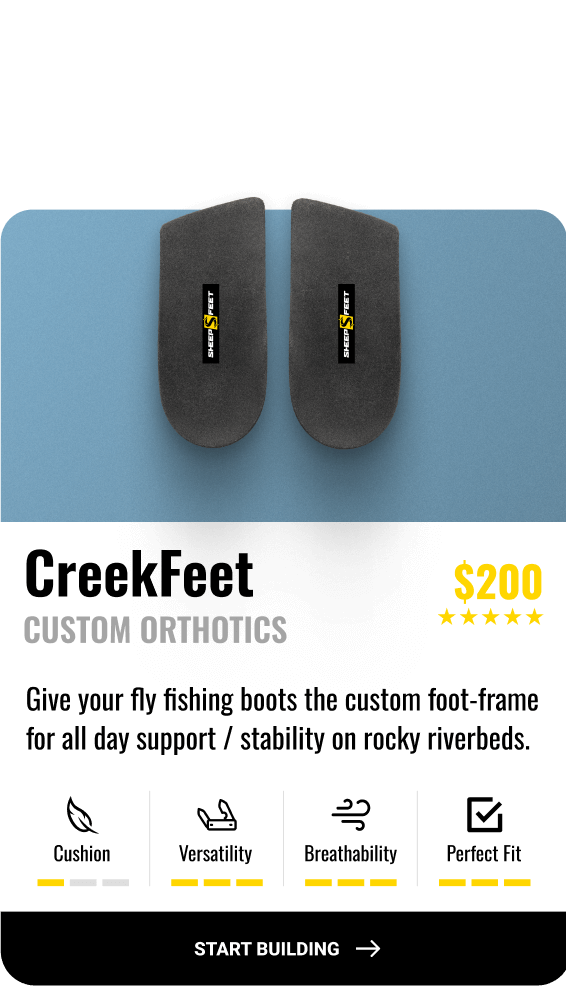
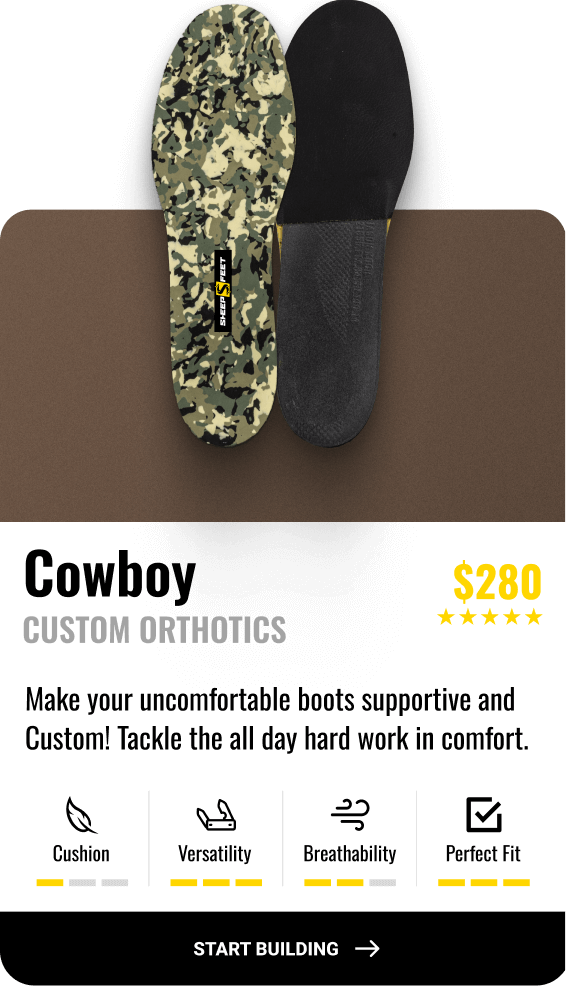
SheepFeet custom orthotics are built from a 3D scan of your specific foot using CastDAR technology in the SheepFeet app — or an Impression Kit if you don't have an iPhone. The fitting takes less than 10 minutes. What you get is a heel cup and arch support built to your exact foot geometry, not a population average, designed to hold its shape under the heaviest pack-out of your season.
How the SheepFeet Fitting Process Works
Train the Muscles. Support the Structure.
SheepFeet custom orthotics are built to your exact foot — fitted in under 10 minutes, made in the USA, backed by a satisfaction guarantee.
SHOP SHEEPFEET CUSTOM ORTHOTICS →Frequently Asked Questions
What foot exercises are best for hunters before a backcountry trip?
The most effective foot exercises for hunters target three areas: ankle stability (single-leg balance, ankle circles), intrinsic foot strength (towel scrunches, toe yoga), and calf/Achilles capacity (calf raises, heel drops). These prepare the small stabilizing muscles in the foot and ankle for the uneven terrain, scree, and downhill loading that backcountry hunting demands.
How soon before hunting season should I start a foot strengthening routine?
Start a dedicated foot and ankle strengthening routine 8 to 12 weeks before opening day. Foot and ankle stabilizer muscles respond more slowly to training than larger muscle groups, so they need a longer runway. Three sessions a week of 15 to 20 minutes is enough to build meaningful stability before season.
Can foot exercises prevent ankle sprains while hunting?
Foot and ankle exercises significantly reduce the risk of ankle sprains by training the stabilizing muscles and improving proprioception. Single-leg balance work, resistance band exercises, and step-downs build the reactive strength that catches a rolling ankle before it becomes a sprain. Combined with a properly fitted boot and custom orthotic that controls heel movement, exercise-trained stability is one of the most effective ways to prevent the injury that ends more hunts than anything else.
Do foot exercises help with plantar fasciitis in hunters?
Yes, specific exercises help manage and prevent plantar fasciitis, though they work best alongside proper structural support. Plantar fascia stretches, calf stretches, and towel scrunches improve tissue flexibility and intrinsic foot strength. However, exercises alone don't address arch support during load-bearing activity — that's where a custom orthotic fitted to your specific arch height comes in alongside the exercise routine.
What's the best exercise for hunters carrying heavy pack weight?
Step-downs and single-leg balance work are the most directly applicable exercises for hunters who carry heavy pack weight, because they train the ankle and foot to stabilize under load on uneven and declining terrain. Calf raises also matter significantly, since the calf and Achilles absorb a disproportionate amount of force on downhill sections when carrying 60 to 100+ pounds.
The Bottom Line
Cardio gets you up the mountain. Leg strength gets the pack on your back up that mountain too. But your feet and ankles are what determine whether you make it down safely, day after day, without a rolled ankle, a stress injury, or a plantar fascia that's screaming by day three.
Train them on purpose. It's fifteen minutes, three times a week, starting now — cheap insurance against the injury that's most likely to end your season early.
Strong Feet Deserve Real Support.
Custom orthotics fitted to your exact foot. Built to hold up to whatever the mountain throws at you.
SHOP SHEEPFEET CUSTOM ORTHOTICS →

