

Foot Pain from Standing on Concrete All Day

By lunch, you can feel it. By the end of the shift, you’re walking to your truck differently than you walked in. By the time you get home, the first thing you do is sit down and take your boots off — and the relief that follows is the only comfort you’ve had in your feet since 6 AM.
If that’s your daily routine, here’s what’s actually happening and why — and more importantly, what actually fixes it instead of just getting you through another shift.
Why Concrete Is Different From Every Other Surface You Stand On
This is not a small distinction. Wood has flex. Asphalt has some give. Dirt and grass compress under your weight. Even tile laid over a wooden subfloor has some structural movement underneath it.
Concrete has none of that. It is, by design, one of the hardest and most rigid surfaces humans have ever invented. That’s exactly what makes it useful for floors, roads, and foundations. And it’s exactly what makes it brutal on feet.
Every pound of force you put into a concrete floor comes straight back at you. Your feet, ankles, knees, hips, and lower back absorb what the floor refuses to share. A review of occupational health studies found consistent evidence linking prolonged standing on hard surfaces to lower limb pain and fatigue — and that’s before you add eight hours, steel-toed boots, and pack weight into the equation.
The pain you feel at the end of a shift isn’t a sign something is wrong with your feet. It’s a predictable mechanical result of asking soft tissue to do a job the floor won’t help with.

What’s Actually Breaking Down in Your Feet
Concrete-standing foot pain isn’t one thing. It’s several specific structures failing in a predictable sequence when they’re under sustained load without adequate support. Here’s what’s happening:
Plantar FasciitisThe most common concrete-standing injury, and the one most tradespeople recognize by name. The plantar fascia is a thick band of connective tissue running from your heel to your toes that supports your arch with every step. On concrete, it absorbs more than its share of impact force with every step. Over thousands of steps per day, it develops micro-tears and inflammation that produce the classic symptom: sharp, stabbing heel pain with your first steps in the morning that partially eases once you’re moving.
If your end-of-day heel pain is becoming morning heel pain, you’re in early-stage plantar fasciitis. It doesn’t get better on its own without addressing the cause.
Arch Collapse and Flat Foot FatigueYour arch is a dynamic structure maintained by a combination of connective tissue and small intrinsic foot muscles. Static standing on concrete — especially without movement — fatigues those muscles faster than walking does, because the muscle-pump action that provides micro-rest with each step is absent. Over a full shift, arches that start the morning with reasonable integrity can flatten significantly by the afternoon, shifting how load distributes across the entire foot and driving pain into the arch and heel.
The calf and Achilles absorb a significant portion of the load from concrete standing, particularly in tradespeople who spend time on their feet but don’t move continuously. Static calf contraction without recovery leads to tightness and end-of-day soreness that extends into the lower leg. Persistent Achilles strain without proper support can progress toward Achilles tendonitis over time.
Foot mechanics affect the entire kinetic chain above them. Overpronation — the inward rolling of the foot that inadequate arch support allows — changes knee tracking, hip alignment, and lower back load. Tradespeople who have chronic lower back pain at the end of every shift, with no obvious injury history, are frequently dealing with a foot mechanics problem, not a back problem.
“Tried every kind of insoles out there — these are the only ones to work with my feet. I stand on concrete floors all day at work then use them for hiking and hunting all the time. Definitely worth the money!”
— Thomas G., Verified SheepFeet CustomerWhy Your Current Solution Isn’t Fixing It
Most tradespeople with chronic concrete foot pain have already tried at least two or three things. Here’s an honest look at what works, what doesn’t, and why:
Anti-fatigue mats
Genuinely helpful — when you can use them. A quality anti-fatigue mat at a fixed workstation provides meaningful shock absorption and reduces static load on the feet significantly. The problem is that most tradespeople aren’t standing in one place. You’re moving, climbing, carrying, pivoting. The mat helps where you stand. It doesn’t help anywhere else.
Better boots
An important piece of the puzzle, but not sufficient on its own. A quality work boot provides ankle support, impact protection, and some midsole cushioning. The factory insole inside it is still a generic foam footbed built to a population average. The boot can be excellent and the insole can still be the weakest link.
OTC insoles (Superfeet, Dr. Scholl’s)
A real improvement over a flat factory footbed. Quality OTC insoles add arch structure and heel cushioning that a factory foam footbed doesn’t provide. The limitation is twofold: they’re built to an average arch height, not yours, and their foam construction compresses under sustained load. By mid-shift on a concrete floor, a foam OTC insole has lost a meaningful portion of its arch support profile. You feel it as the day goes on.
Compression socks
Helpful for circulation and end-of-day swelling. They don’t address the structural load problem at the arch and heel that’s causing the pain in the first place. Compression socks and proper arch support are complementary, not alternatives.
The Structural Fix: What Custom Orthotics Do That Nothing Else Does
Every solution above addresses symptoms. A custom orthotic addresses the root cause: your foot is loading concrete without adequate structural support at the specific arch height and heel geometry your foot actually has.
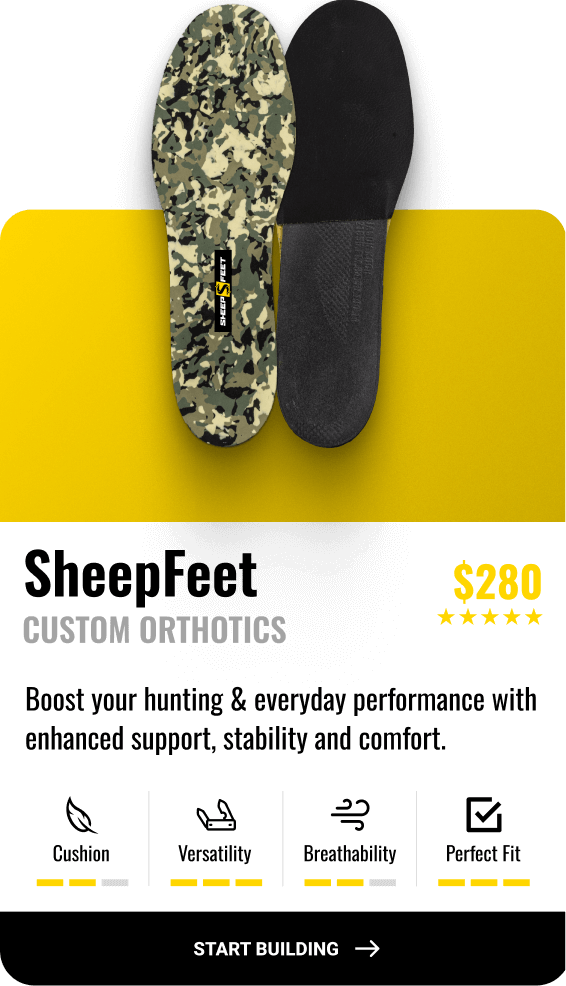
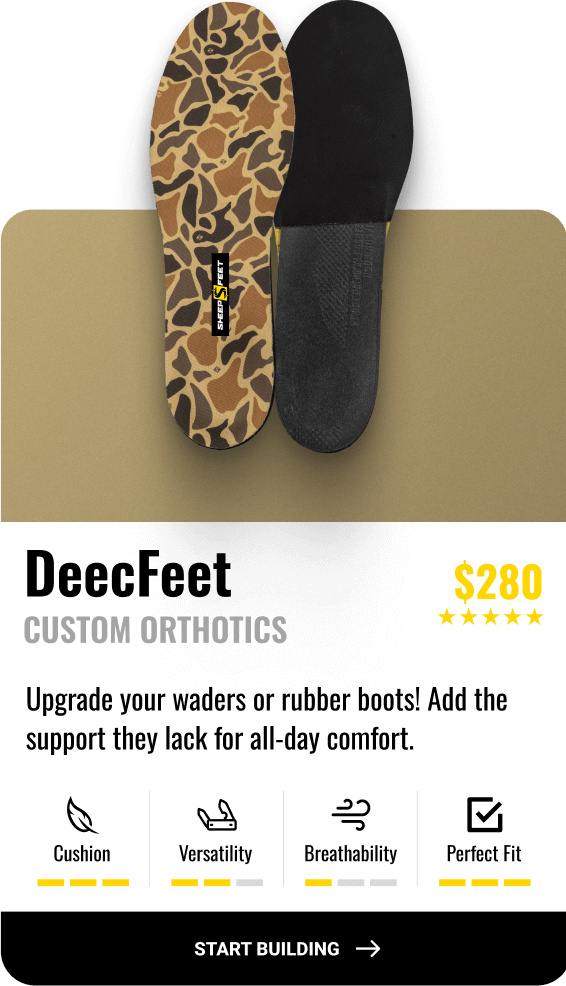
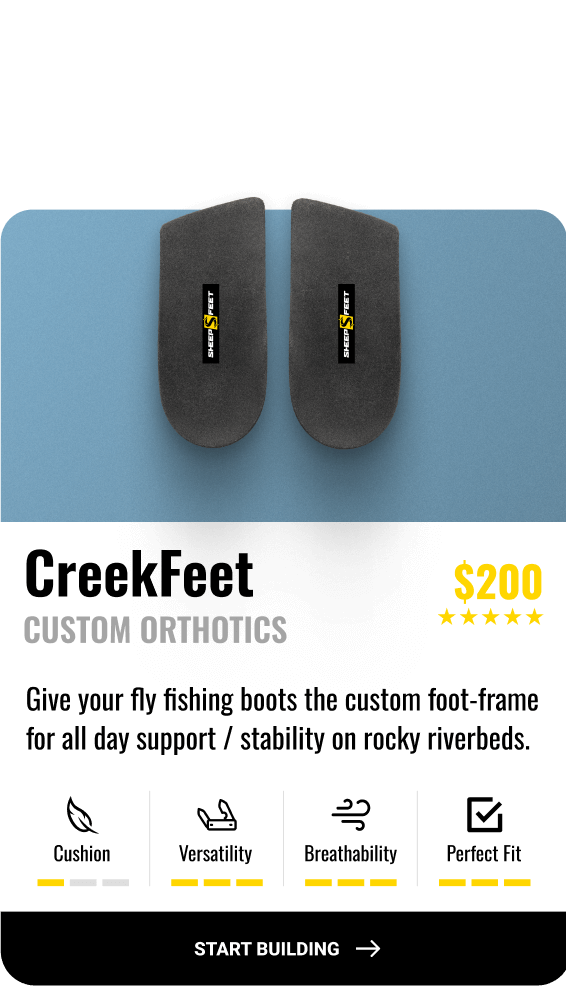
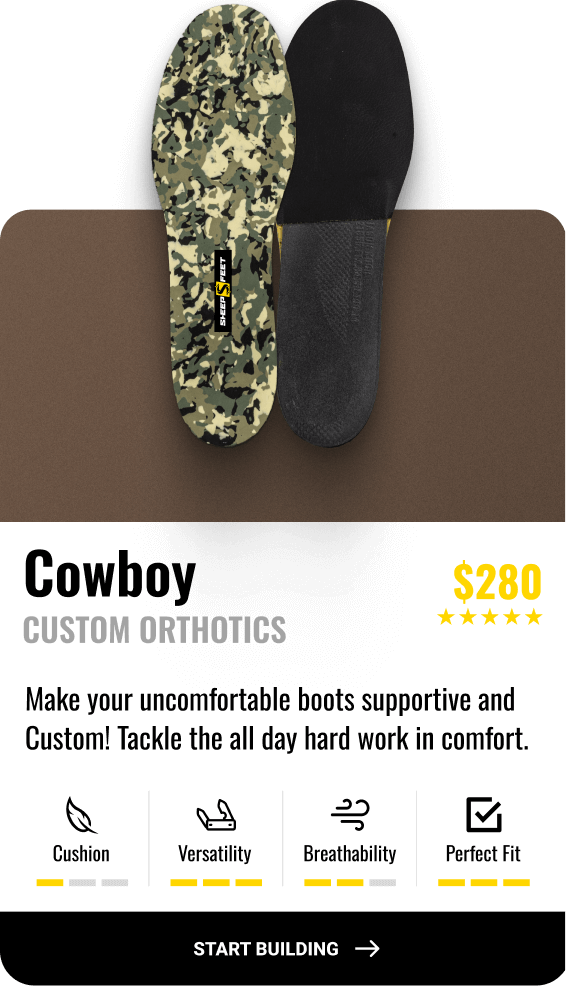
A custom orthotic is built from a 3D scan or mold of your specific foot. The arch support sits at the exact height your arch sits at — not a medium or high average. The heel cup is shaped to your heel geometry, locking it in and preventing the inward roll that drives knee and hip pain upstream. And it’s built on a rigid or semi-rigid shell that holds its support structure for an entire 10-hour shift — not a foam insert that starts compressing by hour three.
For tradespeople specifically, there are two additional practical advantages. First, custom orthotics move between boots — your work boots Monday through Friday, your casual shoes on the weekend, your hiking boots when you’re off. Consistent support regardless of what’s on your feet. Second, they last years, not months. A quality custom orthotic amortizes to $40–95 per year — often less than the OTC insoles you’re already replacing every two to three months on concrete floors.
SheepFeet: 70+ Years of Foot Science, Built for People Who Work on Their Feet
SheepFeet isn’t a startup that decided to sell insoles. Caleb Bowen’s grandfather was a podiatrist. His father studied biomechanics at the School of Podiatric Medicine in Chicago, taught orthotics manufacturing to podiatrists across the country, and spent over 40 years running a commercial orthotics lab that built custom orthotics for doctors and clinics nationwide. Every pair goes through 225 hand-touch processes. Everything is still made in the USA.
The fitting process takes under 10 minutes. Using the SheepFeet iPhone app, you scan your feet with CastDAR technology — a 3D scan capturing your exact arch height, heel geometry, and foot dimensions. No doctor’s office, no waiting room. If you don’t have an iPhone, the Impression Kit ships to you. Free adjustments until they’re right. Full refund if they can’t be. HSA and FSA eligible.
How the SheepFeet Fitting Process Works
Concrete Takes It Out of You. Custom Support Puts It Back.
SheepFeet custom orthotics fitted to your exact foot. Made in the USA. HSA/FSA eligible. Satisfaction guaranteed.
SHOP SHEEPFEET CUSTOM ORTHOTICS →
What to Do Right Now: Daily Habits That Help
While you’re getting fitted for custom orthotics, these daily habits make a real difference:
-
Move when you can. Static standing is harder on feet than walking. Shift your weight, rise onto your toes a few times an hour, and walk during breaks rather than sitting static. Each movement gives the plantar fascia a micro-recovery window.
-
Stretch your calves and arches every morning before your first steps. Pull your toes back toward your shin and hold 30 seconds before standing. Repeat three times. This pre-loads the plantar fascia before it takes full body weight and dramatically reduces morning heel pain.
-
Ice at the end of the shift if plantar fasciitis symptoms are present. Roll the bottom of your foot on a frozen water bottle for 10–15 minutes after work. Reduces inflammation at the fascia insertion point where the pain originates.
-
Replace your work boot insole immediately. Even switching from a flat factory footbed to a quality OTC insole is a meaningful step in the right direction while you wait for custom orthotics. Don’t leave a flat foam slab as the only thing between your foot and the concrete midsole.
-
Elevate after your shift. Feet above heart level for 20–30 minutes after a long day on concrete reduces swelling and helps your circulatory system clear the fluid that accumulates during sustained standing.
“If you’re on the fence about making this investment on yourself, jump right into a pair of SheepFeet! Why? Because your feet are worth it!”
— Rudy V., Verified SheepFeet Customer
Frequently Asked Questions
Why do my feet hurt so much after standing on concrete all day?
Concrete returns every pound of force you put into it with zero absorption. Your feet absorb the full impact of every step and every hour of static standing throughout the shift. Over 8 to 10 hours, that accumulates into inflamed plantar fascia, compressed arch tissue, and significant lower leg fatigue. It is a predictable mechanical result of asking soft tissue to absorb what the floor refuses to share. Proper structural support reduces how much of that load reaches your feet in the first place.
What is the best insole for standing on concrete all day?
The best insole for standing on concrete all day is one built to your specific foot. OTC insoles like Superfeet are a meaningful improvement over flat factory footbeds but are built to an average arch height and compress under sustained load. For tradespeople on concrete 8 to 12 hours per day, a custom Sheepfeet orthotic with a rigid shell holds its support structure throughout the full shift — consistent arch support and heel stability at hour ten that matches hour one.
Can custom orthotics fix foot pain from standing on concrete?
Custom orthotics address the structural root cause by providing arch support at your exact arch height, stabilizing your heel to prevent inward rolling, and distributing load more evenly across the full foot. Most tradespeople who switch to custom orthotics after years of chronic concrete foot pain report significant improvement within 4 to 8 weeks. They don’t fix the floor. They fix the gap between what the floor demands and what your foot can absorb without breaking down.
Why does foot pain from concrete get worse over time?
Foot pain from concrete standing worsens over time because the damage is cumulative. Each shift adds stress to already-inflamed tissue. Without proper structural support, the plantar fascia and Achilles never fully recover between shifts. What starts as end-of-shift soreness can progress over months and years to plantar fasciitis, heel spurs, or chronic arch pain that is present all day. Addressing the structural support issue early significantly changes this trajectory.
Should I see a doctor about foot pain from standing at work?
See a podiatrist if your foot pain is present every day and worsening despite footwear changes, if you have sharp focal heel pain not improving with rest, if you notice visible swelling or a developing bunion, or if the pain has changed how you walk. For most tradespeople with general concrete-standing foot fatigue and early-stage plantar fasciitis, proper footwear, custom orthotics, and a stretching routine resolve the issue without a medical appointment.
The Bottom Line
Concrete doesn’t care how long you’ve been on your feet. It gives back everything you put into it, hour after hour, shift after shift. The tradespeople who stop having foot problems aren’t the ones who toughen up — they’re the ones who stop asking their feet to absorb what a properly fitted insole should be handling for them.
Your feet carry you through every shift you work. They’re the most important piece of equipment you own and probably the least maintained. Give them the same standard of care you’d give any other tool that has to show up and perform every single day.
Your Most Important Tool Deserves Real Support.
Custom orthotics built to your exact foot. Lasts years, not months. HSA/FSA eligible. Made in the USA.

