

The Real Cost of Not Treating Foot Pain as a Hunter

Most hunters think of foot pain as a cost of doing business. You hunt hard, your feet pay for it. You tape up, take some ibuprofen, manage it through the season. It's just part of hunting.
What most hunters don't do is add up what that approach is actually costing them -- in real dollars, in lost days, in seasons they'll never get back. The math is more uncomfortable than the foot pain.
This article does the accounting that most hunters avoid. Not to sell you something -- but because understanding the real cost is the only way to make a genuinely rational decision about whether to fix the problem or keep managing it.
🔗 Why Your Feet Hurt After Hunting — And What to Do About It
🔗 Plantar Fasciitis and Hunting: What Every Hunter Needs to Know
The Costs Most Hunters Never Add Up
Foot pain has a purchase price and a real price. The purchase price is what you spend on tape, ibuprofen, insoles, and occasional podiatrist visits. The real price is everything else -- and it's almost always larger.
The Lost Hunt Cost
A single missed day of an elk hunt costs more than most hunters realize when they add it up honestly. Consider a typical western elk hunt: non-refundable OTC tag ($50-$800 depending on state), license ($40-$60), travel ($300-$2,000 depending on distance), outfitter or camp costs if applicable ($0-$3,000+). When foot pain forces a hunter to cut the trip short by two days, or ends the hunt entirely, none of those costs come back.
|
The Real Cost of One Lost Elk Hunt Day Proportional tag cost (7-day hunt, lose 2 days): $150-$400 Proportional travel cost (lose 2 of 7 days): $100-$600 Proportional camp/outfitter cost: $0-$900 Lost opportunity cost (elk pass that you couldn't reach): Incalculable Minimum real cost of 2 lost hunt days: $250-$1,900 Cost of SheepFeet custom orthotics (amortized, 1 season): $56-$93 |
The Symptom Management Cost
The ongoing cost of managing foot pain without fixing it adds up faster than most hunters expect. Across a season -- and across multiple seasons -- the spend on temporary relief often exceeds the cost of permanent structural correction.
|
Annual Symptom Management Spend (Typical Hunter with PF) OTC insoles replaced annually (Superfeet): $55 Leukotape and blister supplies: $30-$50 Ibuprofen (heavy hunting season use): $20-$40 Podiatrist visit + cortisone injection (every 1-2 years): $150-$400 Physical therapy (if condition escalates): $200-$800 Annual symptom management cost: $255-$545 SheepFeet per season (5-year lifespan): $56 Net savings with SheepFeet vs symptom management: $199-$489/year |
The Compounding Injury Cost
The most expensive foot pain is the kind that escalates into something more serious. And it escalates predictably when the structural cause isn't addressed.
|
⚠ The escalation timeline most hunters don't see coming Year 1: Manageable heel soreness, treated with tape and ibuprofen. Year 2: Plantar fasciitis confirmed, cortisone injection, limited pre-season training. Year 3: Mid-season tear during pack-out. Surgery. 6-month recovery. Full season missed. Year 4: Partial return to hunting with permanent vulnerability. Total cost of years 1-4: $3,000-$15,000+ in medical costs, lost hunts, and travel. Cost of addressing the structural cause in Year 1: $280. |

The Performance Cost: What Foot Pain Takes From Your Hunt
Beyond the financial accounting, foot pain imposes a performance cost that doesn't appear on any invoice but shapes every hunt it touches. It's the most expensive cost because it's the hardest to quantify and the easiest to rationalize away.
Reduced Daily Mileage
A hunter managing plantar fasciitis pain covers fewer miles per day. Not dramatically fewer -- just enough that they take the shorter route, skip the steeper drainage, stay on the ridge instead of dropping into the canyon. Each of those decisions is a hunt that didn't happen. The elk that was in that canyon, the bull that was using that drainage -- they were there. The hunter's feet decided not to go.
Terrain Avoidance
Foot pain changes where hunters go. Steep descents become something to manage rather than something to use. Remote basins that require a difficult approach become unattractive. The best elk country is steep, remote, and demanding -- exactly the terrain that foot pain makes hunters avoid. Every year of hunting with inadequate foot support is a year of hunting the accessible country while the elk stay in the difficult country.
Decision-Making Degradation
By day four of a seven-day hunt, a hunter managing significant foot pain is making decisions differently than a hunter whose feet feel fine. Pain narrows focus. It shortens time horizons. It makes getting back to camp more attractive than staying in the field. The elk that showed up at last light on day four -- the hunter with foot pain was already headed back. The hunter without it was still watching.
The Secondary Injury Problem
Foot pain changes how you walk. The changed gait loads your knees, hips, and lower back in ways they weren't designed for. The foot problem that started as plantar fasciitis becomes a knee problem, then a hip problem, then a reason to limit hunting entirely. The secondary injuries from gait compensation can outlast the original foot issue by years.
|
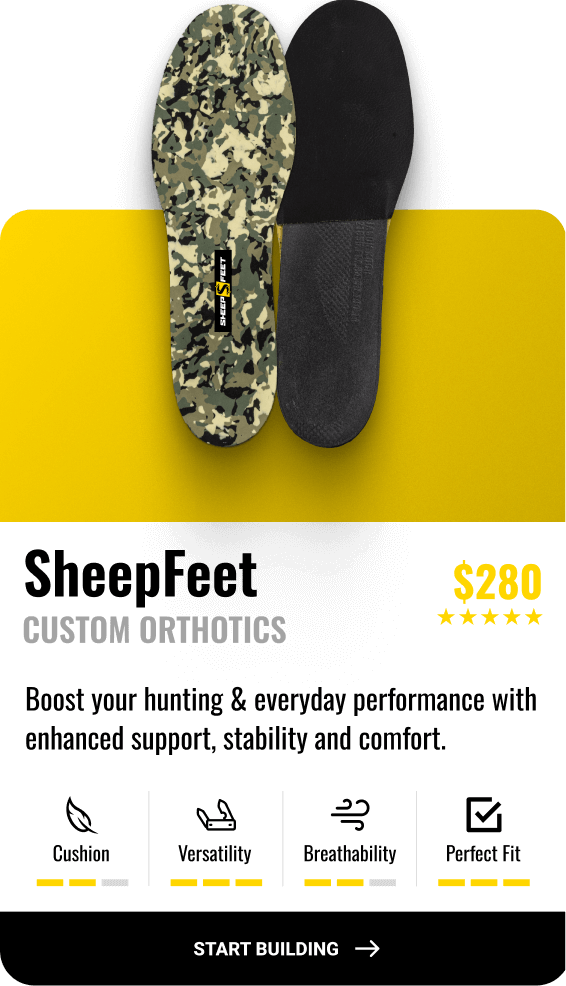
Stop Paying the Real Price SheepFeet custom orthotics fix the structural root cause of hunting foot pain. $280. Lasts 3-5 seasons. Built for your foot, designed for the mountain. |
The Season You'll Never Get Back
There's a cost category in hunting that has no dollar value: the seasons. Every hunting season is finite and unrepeatable. The elk hunt at 42 is not the same as the elk hunt at 52. The backcountry you can cover at 38 is not the same backcountry you can cover at 48. Every season spent managing foot pain instead of hunting without it is a season partially lost -- not financially, but in the irreplaceable currency of time in the field.
The hunters who treat foot pain as a cost of doing business accept this loss as inevitable. It isn't. The structural issues that cause hunting foot pain -- arch collapse, plantar fasciitis, inadequate heel support -- are fixable. They've been fixable since the first fitting. Every season that passes before fixing them is a season that didn't have to be compromised.
|
💡 The question worth asking How many days of how many hunting seasons have your feet been the limiting factor? Not the only factor -- the limiting one. If the answer is more than zero, you already know the calculation. |
The Fix -- And What It Actually Costs
The solution to structural foot pain in hunting is structural support. Not tape, not ibuprofen, not a cortisone injection that wears off -- an orthotic built for your specific foot that holds your arch in its correct biomechanical position throughout the loading cycle of a hard hunt.
SheepFeet custom orthotics:
-
Fitted to your foot: Are fitted to your specific foot using CastDAR technology via the iPhone app or the Impression Kit -- no appointment required
-
Holds under load: Maintain their arch support geometry under heavy pack load -- unlike OTC options that compress within miles
-
Built to last: Last 3-5 seasons of regular hunting use -- unlike annual OTC replacement
-
Cost per season: Cost $280 -- $56-93 per season amortized, comparable to or less than ongoing symptom management
-
Fixes the cause: Fix the structural root cause -- so the pain stops compounding into more serious injury
Every dollar spent on foot pain symptom management is a dollar that didn't fix the problem. Every hunt compromised by foot pain is a hunt that didn't have to be. The math on getting this right is overwhelmingly clear -- the only variable is when.
🔗 How the SheepFeet Fitting Process Works
🔗 Are Custom Orthotics Worth It for Hunters?
The Full Cost Comparison: Fix It vs. Manage It
|
Manage the Symptom |
Fix the Cause (SheepFeet) |
|
|---|---|---|
|
Year 1 cost |
$255-$545 (supplies + visits) |
$280 (one-time) |
|
Year 2 cost |
$255-$545 |
$0 (same orthotics) |
|
Year 3 cost |
$255-$545 (or more if escalated) |
$0 |
|
3-year total |
$765-$1,635+ |
$280 |
|
Lost hunt days |
Ongoing |
Zero (once corrected) |
|
Escalation risk |
High -- condition compounds |
Eliminated |
|
Performance ceiling |
Permanent |
Removed |
|
Seasons compromised |
Every season until fixed |
Zero after fitting |

Frequently Asked Questions
What is the real cost of foot pain for hunters?
The real cost includes non-refundable licenses and tags lost when hunts are cut short, travel costs that cannot be recovered, reduced daily mileage that lowers hunting success, gait compensation injuries to the knee and hip that can cost multiple seasons to recover from, and in severe cases the cost of a plantar fascia tear requiring surgery. A single lost elk hunting season typically costs $2,000 to $10,000 or more when all costs are accounted for.
Can untreated foot pain end a hunting season?
Yes. Plantar fasciitis, arch collapse, and gait compensation injuries end hunting seasons every year. The condition escalates predictably under multi-day hunting load when the structural cause is not addressed. A partial or full plantar fascia tear in the backcountry is a medical situation requiring evacuation. Addressing foot pain before the season with proper structural support is the only reliable way to prevent this outcome.
How does foot pain affect hunting performance?
Foot pain reduces daily mileage, causes terrain avoidance, degrades decision-making under sustained discomfort, and triggers gait compensation that overloads the knee, hip, and lower back. Hunters in pain consistently cover less country and make risk-averse decisions that reduce their probability of encountering game -- often without fully recognizing the connection.
Is it cheaper to fix foot pain or keep treating the symptoms?
Fixing the structural root cause is cheaper over any meaningful time horizon. Annual symptom management costs $255-$545 per year for a typical hunter with plantar fasciitis. SheepFeet custom orthotics at $280 amortized over five seasons cost $56 per season and fix the cause rather than managing the symptom.
What happens if plantar fasciitis goes untreated in hunters?
Untreated plantar fasciitis escalates predictably: manageable early inflammation progresses to mid-stage pain limiting daily mileage, then to late-stage constant pain, and in the most serious cases to a partial or full tear requiring surgery and six to twelve months of recovery. Addressing the structural cause at any stage halts the escalation -- but the earlier it's addressed, the lower the total cost.
Are custom orthotics a good investment for hunters?
Yes. At $56-$93 per season amortized, SheepFeet custom orthotics cost less than a single day of a missed elk hunt when licenses, tags, and travel are factored in. For any hunter whose feet have ever limited their hunt, custom orthotics are among the highest-return gear investments available.
The Bottom Line
The cost of not treating foot pain isn't the cost of the tape and ibuprofen. It's the hunts that got shorter. The country that didn't get covered. The seasons that were harder than they needed to be. Add those up across ten years of hunting through manageable foot pain and you'll find a number that makes $280 look like the most efficient purchase you ever made.
The fix has been available the whole time. The only question is which season you decide to use it.
The Off-Season Is the Right Time to Fix This
SheepFeet custom orthotics — fitted from home with CastDAR technology, built for your foot, designed for the mountain. $280. Lasts 3–5 seasons. Ships to your door.
SHOP SHEEPFEET CUSTOM ORTHOTICS →

