

How to Carry 80 Lbs Without Destroying Your Feet

You tagged your bull on day four. Now you have six miles of mountain between you and the truck, a boned-out elk in your pack, and feet that have already put in sixty miles this week. The next four hours will either be a story you tell for twenty years or the moment your feet finally quit on you.
Pack-outs are where hunters find their limits. Most of those limits aren't cardiovascular — they're structural. The feet and legs give out long before the lungs do on a serious pack-out, and almost all of that failure is preventable with the right preparation and the right support system.
This article covers the biomechanics of why heavy load destroys feet, and the six strategies serious hunters use to pack out hard without paying for it for the next two weeks.
🔗 Why Your Feet Hurt After Hunting — And What to Do About It
🔗 Plantar Fasciitis and Hunting: What Eve
The Physics of Pack-Out Foot Damage
Most hunters think of pack-out foot pain as a simple math problem: more weight equals more pain. The reality is more complex — and understanding it explains why some hunters carry 90 lbs without incident while others are limping at 50. The damage isn't just from the weight. It's from where the weight goes.
The Force Multiplier on Descents
On flat terrain, your pack weight adds roughly proportional load to your feet — 70 lbs on your back means about 70 extra lbs distributed across each step. On a downhill slope, the physics change dramatically. Deceleration mechanics on a 15% grade with a 70 lb pack can generate three to four times the pack weight in force through your heel on each foot strike. That's 210–280 lbs of effective force, repeated thousands of times per mile.
Load force by terrain and pack weight:
|
Terrain |
Pack Weight |
Effective Heel Force |
Primary Risk |
|---|---|---|---|
|
Flat trail |
40 lbs |
~50 lbs |
Fatigue, minor friction |
|
Flat trail |
80 lbs |
~100 lbs |
Arch fatigue, blister |
|
15% descent |
40 lbs |
~120–160 lbs |
Plantar fascia strain |
|
15% descent |
80 lbs |
~240–320 lbs |
High PF tear risk, knee |
|
30% descent |
80 lbs |
~400+ lbs |
Severe — trip if no support |
|
⚠ The most dangerous mile of any pack-out The last mile. Fatigue has compounded, arch support has compressed, gait mechanics have deteriorated, and you're pushing harder to finish. This is when most serious foot injuries on pack-outs occur. Slow down, shorten your stride, and pay attention to what your feet are telling you. |
Why Arch Support Fails Under Heavy Load
Generic insoles — including premium over-the-counter options — are made from materials that compress under sustained heavy load. A Superfeet insole that tests well at the trailhead may have lost 30–40% of its arch support profile by mile five of a loaded pack-out. The arch collapses progressively, the plantar fascia takes over the support role it was never designed to carry alone, and the damage accumulates mile by mile.
Custom orthotics built on a rigid or semi-rigid shell maintain their structural geometry under load — the support doesn't compress away when you need it most. This is the single most important performance difference between custom and generic support on a serious pack-out.

6 Strategies for Pack-Out Foot Performance
These strategies compound — each one reduces foot damage independently, and together they make the difference between arriving at the truck with something left in the tank and arriving unable to walk properly for three days.
1. Start With the Right Foundation: Custom Arch Support
Everything else on this list is damage mitigation. This is damage prevention. A custom orthotic fitted to your specific foot is the highest-leverage single change most hunters can make for pack-out performance. It maintains arch support under heavy load, holds the heel in neutral on descents to reduce plantar fascia stress, and distributes force across the entire foot rather than concentrating it at the heel.
If you're reading this before your next pack-out: get fitted before the season. If you're reading this after a rough one: this is the fix to the root problem.
🔗 Custom Orthotics vs. Stock Insoles: An Honest Comparison for Hunters
2. Use a Pack Frame That Transfers Weight to Your Hips
A pack that loads your shoulders instead of your hips amplifies the force through your feet on every step — because your upper body mass isn't being supported by your skeletal structure efficiently. A properly fitted external or internal frame pack with a rigid hip belt should transfer 70–80% of the load to your hips and glutes. Your feet carry the remaining load, but they're working with your strongest muscle groups rather than compensating for a poorly loaded pack.
|
💡 Pack fit matters as much as pack weight Before every season, load your pack to hunting weight and have someone watch you walk. If your shoulders are rolling forward and your upper back is rounding, the hip belt isn't doing its job. Adjust until your torso is upright and the hip belt is snug on your iliac crest — not on your waist. |
3. Train for Pack Weight Before the Season
The best predictor of pack-out foot performance is how many weighted miles you've logged in training. Your feet — specifically the plantar fascia, Achilles tendon, and arch musculature — adapt to progressive load over time, just like any other connective tissue. A hunter who has done ten training hikes with 40–60 lbs arrives at the pack-out with tissues that are conditioned for the demand.
The protocol: start 8 weeks before your hunt with a 30-minute weighted hike at 30% of your body weight. Add 10 minutes and 5 lbs per week. By week 8, you should be covering 90 minutes at close to full pack weight. Do this on terrain similar to what you'll hunt — stairs and a treadmill don't replicate mountain descent mechanics.
4. Control Your Descent Technique
Descent technique is where most pack-out foot damage is generated — and where most hunters have the most untapped improvement. Three technique changes reduce heel strike force significantly:
-
Shorter stride: Shorten your stride by 30–40% on steep descents — longer strides increase deceleration force dramatically
-
Soft knee landing: Land with a slight knee bend rather than a locked leg — your quadriceps absorb force that would otherwise go straight to your heel
-
Traverse vs. direct descent: Traverse steep grades at a diagonal angle where possible rather than heading straight down — reduces the grade your foot is managing on each step
5. Manage Load Actively During the Pack-Out
Most hunters load their pack at camp and carry it unchanged to the truck. Strategic load management reduces cumulative foot damage significantly:
-
Cache the heaviest meat quarters closest to the truck and make multiple lighter trips rather than one maximum-weight trip — your feet handle the first carry better than the fifth mile
-
Take a genuine 10-minute rest every 60–90 minutes — sit, elevate your feet, and let tissue pressure normalize before the next push
-
Redistribute pack weight across multiple bags if carrying two people's loads — two 50 lb packs are dramatically kinder to feet than one 100 lb pack
6. Active Recovery at Camp Between Pack-Out Trips
For multi-day pack-outs — multiple trips from kill site to camp to truck — overnight recovery is the difference between being functional on day two and being hobbled. The protocol:
-
Remove boots immediately at camp and change into supportive recovery footwear — never go barefoot on hard ground
-
Elevate feet above heart level for 20 minutes to reduce inflammatory fluid buildup
-
Ice heel and arch for 15 minutes if any plantar fasciitis pain is present
-
Perform plantar fascia stretching — pull toes toward shin, hold 30 seconds, repeat 3 times per foot
-
Eat adequate protein before sleeping — connective tissue repair requires amino acids, and most hunters under eat protein during high-output hunting days
|
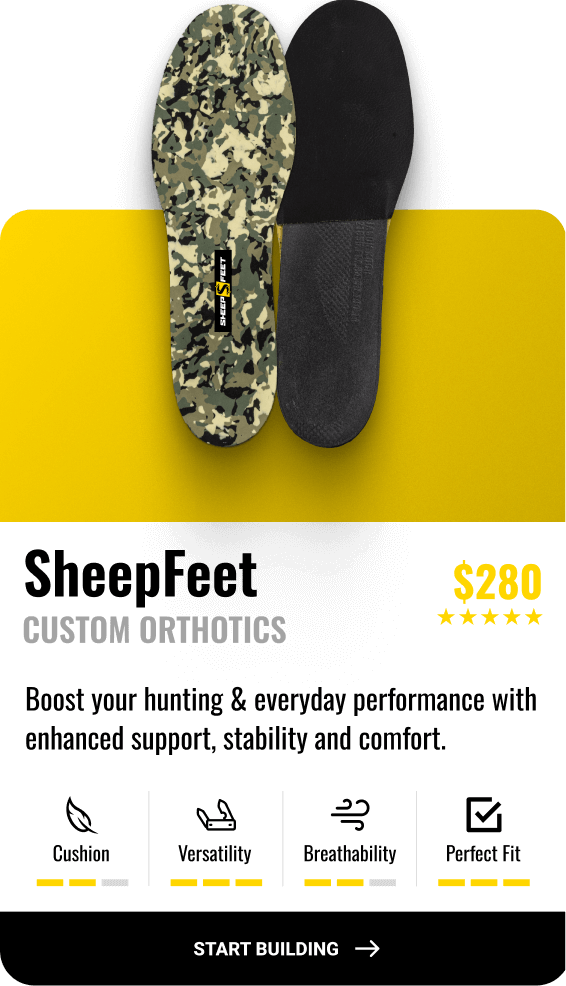
The Foundation Every Pack-Out Needs SheepFeet custom orthotics maintain their arch support under full pack load — built for your specific foot, designed for mountain hunting terrain. |
The Pack-Out Foot Care Kit
Beyond the insole, every serious backcountry hunter should carry a minimal foot care kit on any pack-out. Weight below 4 oz, impact potentially enormous:
|
Item |
Why It's Worth the Weight |
|---|---|
|
Leukotape P (6-inch strip) |
Pre-apply to heel and ball of foot at trailhead. Prevents the blister that changes your gait and multiplies all other damage. |
|
Ibuprofen (6 tablets) |
Anti-inflammatory for end-of-day tissue recovery. Not for masking pain during carry — for overnight inflammation reduction. |
|
Dry sock pair |
Change at midpoint of a long carry if moisture has built up. Wet skin blisters faster and fatigues faster under friction. |
|
Trekking poles |
Reduce lower body load by 25% on descents by distributing force to arms. Material change in heel strike force over miles. |
|
Electrolyte tabs |
Dehydration accelerates muscle fatigue and reduces connective tissue elasticity — the arch fatigues faster when you're under-hydrated. |
|
💡 The trekking pole case for hunters Many hunters resist trekking poles as unnecessary gear. On a flat-terrain hunt, that's defensible. On a steep mountain pack-out with 80 lbs of meat, poles reduce effective foot load by roughly 25% on descents — that's the difference between making it out in one trip and needing two. The weight of two poles is about 18 oz. The weight saved on your feet across 6 miles of descent is incalculable. |

Pre-Season Pack-Out Preparation Checklist
The time to prepare your feet for a pack-out is not the morning of the pack-out. It's eight weeks before the season opens:
-
8 weeks out: Get fitted for custom orthotics and break them in with every training hike
-
8 weeks out: Begin progressive weighted hikes — 30 lbs increasing to full pack weight over the training block
-
6 weeks out: Confirm pack fit is correctly transferring load to hips at full weight
-
4 weeks out: Do two hikes specifically on steep downhill terrain to adapt to descent mechanics
-
2 weeks out: Complete one full-weight, long-distance training hike matching your expected pack-out distance
-
Final 2 weeks: Rest — final two weeks should be maintenance hikes only, letting connective tissue consolidate the adaptation
Frequently Asked Questions
How do I carry heavy weight on a pack-out without foot pain?
Six strategies work together: custom orthotics for sustained arch support under load; a properly fitted pack frame transferring weight to your hips; progressive pre-season weighted training; active descent technique using shorter strides and soft knee landings; strategic load management with rest breaks; and active foot recovery at camp between trips. The insole is the highest-impact single change for most hunters.
Why do my feet hurt so much after a pack-out?
Pack-out foot pain is caused by cumulative mechanical overload — particularly the force multiplier on descents, where effective heel strike force can reach three to four times your pack weight. Without custom arch support, the plantar fascia absorbs this force repeatedly until it develops micro-tears and inflammation. The pain is structural, and structural support is the fix.
How much weight is too much to carry on a hunt?
There's no universal limit — it depends on your support, terrain, distance, and conditioning. A hunter with custom orthotics and a properly fitted pack can carry 80 lbs or more with significantly less foot damage than a hunter with flat factory insoles carrying 50 lbs. Any load exceeding 30% of your body weight over mountain terrain requires proper support and active recovery protocols.
What are the best insoles for pack-out hunting?
Custom orthotics are the most effective insoles for pack-out hunting because they maintain their support geometry under heavy load — unlike generic insoles that compress and lose their arch support profile within a few miles of loaded hiking. SheepFeet custom orthotics are designed specifically for mountain hunters and backcountry pack-out conditions.
How do I recover my feet after a hard pack-out?
Elevate feet above heart level for 20 minutes to reduce swelling. Ice heel and arch for 15 minutes if plantar fasciitis pain is present. Perform plantar fascia stretching. Change into supportive recovery footwear rather than walking barefoot on hard floors. Ensure adequate protein and hydration for overnight tissue repair.
Does pack weight cause plantar fasciitis?
Yes — heavy pack weight is one of the primary triggers for plantar fasciitis in hunters. The force through the plantar fascia on steep descents under load can reach three to four times the pack weight. Without adequate arch support, the plantar fascia absorbs this force and develops the micro-tears that cause plantar fasciitis.
The Bottom Line
Pack-outs are the ultimate test of your gear and your preparation. The hunters who make it out with something left — who aren't limping for a week after — have solved the same problem: they've given their feet a support system that matches the demands of the task.
That starts with a custom orthotic that maintains its support under full load. It's reinforced by a properly fitted pack, a trained body, smart technique, and the discipline to recover actively between carries.
You put in the work to find the animal. Put in the same care to get it out.
The Foundation Every Pack-Out Needs
SheepFeet custom orthotics maintain their arch support under full pack load — built for your specific foot, designed for mountain hunting terrain.
SHOP SHEEPFEET CUSTOM ORTHOTICS →


