

Can You Hunt With Plantar Fasciitis?

The short answer is: it depends. And that answer is going to frustrate you if you've been hoping someone would just say yes or no. But the honest truth is that whether you can hunt with plantar fasciitis comes down to which stage you're in, what terrain you're covering, how much weight you're carrying, and whether you have the right support in your boots.
What we can tell you with certainty: hunting through plantar fasciitis without addressing the root cause is how a manageable condition becomes a season-ending injury. The hunters who make it through a hard hunt with plantar fasciitis are the ones who prepared correctly. The ones who don't are the ones who ignored it and hoped it would hold.
This article gives you the honest framework — stage-by-stage risk assessment, the field protocol serious hunters use to manage it in the moment, and how to fix the root cause so it stops being a question every season.
🔗 Plantar Fasciitis and Hunting: What Every Hunter Needs to Know
🔗 Why Your Feet Hurt After Hunting — And What to Do About It
“What an amazing custom insole! The process was super easy and simple. A couple of weeks later you have a great product ready for the field. I have used mine for a couple of months now and my feet and back feel so much better! These are literally custom made to your feet so they are a perfect fit.”
— Verified SheepFeet Customer
The Honest Risk Assessment: Stage by Stage
Plantar fasciitis is not one condition — it exists on a spectrum from early inflammation that most hunters barely notice to late-stage damage that puts you at genuine risk of a tear in the field. Where you are on that spectrum determines what you can safely do.
|
Stage |
Key Symptoms |
Huntable? |
Required Action |
|---|---|---|---|
|
Early |
Morning heel soreness that fades in minutes, mild arch stiffness, tender heel to pressure |
Yes -- with support |
Custom orthotics or strong OTC support, heel-lock lacing, morning stretch protocol |
|
Mid |
Morning pain lasting 20+ min, sharp pain on first step each day, pain returns end of day |
Caution |
Custom orthotics mandatory, taping, anti-inflammatories, shorter daily mileage |
|
Late |
Constant heel pain, pain during normal walking, any swelling or bruising |
No -- high risk |
Medical evaluation before hunting, do not attempt multi-day backcountry |
|
Suspected tear |
Sudden sharp pain mid-stride, inability to bear weight, severe swelling |
No -- emergency |
Stop immediately, exit the field, seek medical attention |
|
⚠ The most dangerous decision in hunting with plantar fasciitis Taking ibuprofen before a hunt to reduce pain without addressing the underlying support deficit. Anti-inflammatories reduce the pain signal that tells you when you're approaching a tear threshold. Hunting hard on masked pain is how partial tears become full tears in the backcountry. |
Why Hunting Conditions Make Plantar Fasciitis Worse Faster
Plantar fasciitis that feels manageable on your morning walk to the truck can become debilitating by day three of an elk hunt. The conditions of backcountry hunting create a specific acceleration pattern that most hunters don't anticipate:
The Pack Weight Multiplier
On a steep descent with 70 lbs of meat, the force through your plantar fascia can reach three to four times your pack weight per heel strike. Thousands of those repetitions per mile, across multiple miles per day, on already-inflamed tissue. The condition doesn't hold steady under these conditions — it compounds.
No True Recovery Between Sessions
A training athlete with plantar fasciitis has rest days. A hunter on a seven-day backcountry hunt does not. Each morning starts with more cumulative damage than the day before. The tissue never has the overnight window it needs to complete the repair cycle before being loaded again.
Cold Morning Loading
Cold contracts the plantar fascia and reduces its elasticity. First steps in the morning on a cold hunting day load tight, inelastic tissue. This is the highest-risk moment for micro-tears to become macro-tears — and it happens every single morning of a multi-day hunt.
Terrain Variety
Uneven mountain terrain creates lateral loading forces that flat-ground walking doesn't. Off-camber terrain, stream crossings, and rocky sidehills put the plantar fascia under stress in directions it isn't conditioned for — adding risk on top of the straightforward heel-strike loading.

The Field Protocol: Managing Plantar Fasciitis During a Hunt
If you're already in the field with plantar fasciitis — or if you've made the decision to hunt with early-to-mid stage symptoms — this is the protocol that gives you the best chance of getting through the hunt without making it significantly worse. This is management, not a cure. The cure is proper structural support.
Every Morning Before Boots Go On
-
1. Stretch before your first step -- pull toes toward shin, hold 30 seconds, repeat 3 times per foot. Do this while still in your sleeping bag or on your cot before standing.
-
2. Apply arch support taping -- figure-8 pattern with Leukotape P from heel to mid-foot. YouTube 'plantar fasciitis taping' for the visual technique if unfamiliar.
-
3. Take ibuprofen with food to reduce overnight inflammation -- not to enable harder pushing.
-
4. Install your orthotics or best available insoles before lacing -- never hunt in factory insoles with plantar fasciitis.
-
5. Use heel-lock lacing to prevent heel lift on ascents -- this is where most additional micro-tear damage occurs.
During the Hunt
-
1. Walk the first quarter-mile at a slower pace to warm the fascia before ascending or loading.
-
2. Shorten stride by 30% on all descents -- reduced stride = reduced heel-strike force = reduced tear risk.
-
3. At any rest stop longer than 20 minutes, do two sets of plantar fascia stretches before resuming.
-
4. Stop and re-tape if pain escalates significantly -- do not push through sharp pain increases.
Every Evening at Camp
-
1. Remove boots immediately and elevate feet for 20 minutes.
-
2. Ice heel and arch for 15 minutes -- a frozen water bottle works well in the backcountry.
-
3. Gentle stretching -- calf stretches against a tree, toe pulls, plantar fascia massage with a hard object like a tent stake handle.
-
4. Sleep in supportive camp footwear -- not barefoot on hard tent floors.
|
💡 The most overlooked camp recovery step Most hunters skip the evening stretch routine because they're exhausted and dinner is ready. This is the single highest-value time investment for plantar fasciitis management on a multi-day hunt. Five minutes of evening stretching and icing dramatically affects how the tissue responds the following morning. Make it non-negotiable. |
“These are worth every penny. I know they don’t claim they will fix medical conditions but these have made a world of difference with my plantar fasciitis. Aside from that, they keep my feet so much more comfortable when hiking or doing anything. I wear them almost every day now.”
— Verified SheepFeet Customer, Plantar Fasciitis Sufferer
|
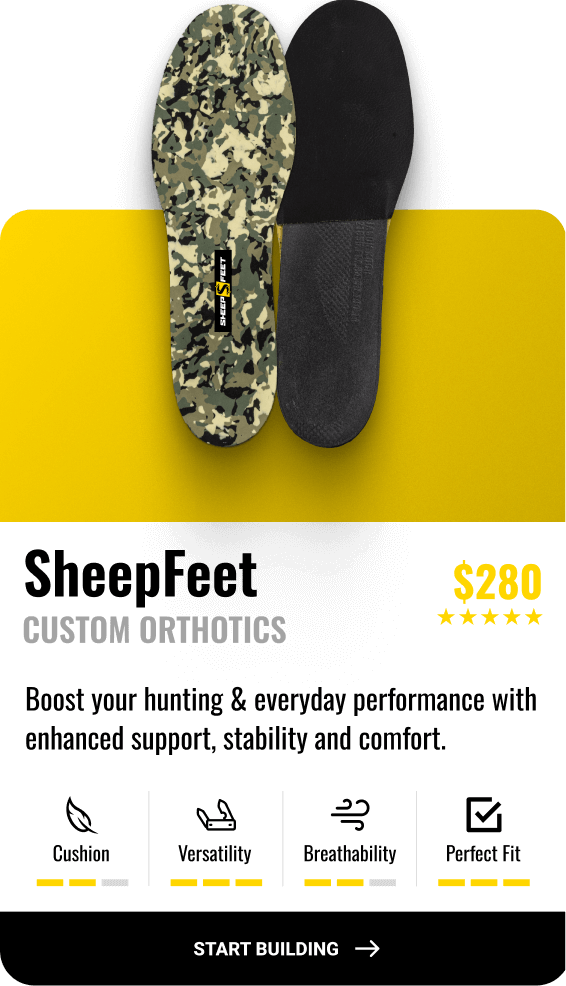
Fix the Root Cause Before the Season SheepFeet custom orthotics address the structural support deficit that causes plantar fasciitis in hunters. Get fitted before the season -- not after the injury forces your hand. |
The Real Fix: Addressing the Root Cause
Everything in the field protocol above is damage control. It buys time and reduces escalation risk. It does not fix plantar fasciitis. The condition comes back every season until the structural root cause is addressed.
For the overwhelming majority of hunters, the root cause is the same: the plantar fascia is being asked to provide arch support that should be provided by the insole. The generic factory insole leaves the arch unsupported. The plantar fascia compensates. Under the repeated heavy loading of backcountry hunting, it fails.
The fix is a custom orthotic that provides the support the plantar fascia was being asked to generate on its own. When the arch is properly supported throughout the loading cycle, the plantar fascia can rest and recover. Most hunters who implement proper custom arch support after years of recurring plantar fasciitis find the condition resolves within one to two seasons.
What This Looks Like Before Next Season
-
Get fitted for custom orthotics as soon as the current season ends -- give the tissue the full off-season to heal with proper support
-
Begin a plantar fascia stretching routine immediately -- daily toe pulls and calf stretches, every morning before first steps
-
Install your orthotics in every pair of shoes you wear daily -- not just your hunting boots. The fascia doesn't take breaks because you changed shoes
-
Do your pre-season training hikes with your actual hunt orthotics inside your actual hunt boots -- every mile of adaptation counts
-
See a podiatrist if the condition is mid-stage or worse -- get a professional assessment alongside the structural correction
🔗 Custom Orthotics vs. Stock Insoles: An Honest Comparison for Hunters
🔗 How the SheepFeet Fitting Process Works
When You Should Not Hunt
The hardest part of this article to write — and the most important. There are situations where the correct answer to 'can I hunt with plantar fasciitis' is a clear no, and a hunter who ignores that answer risks consequences that go well beyond a lost season.
|
⚠ Do not hunt in these conditions Late-stage plantar fasciitis with constant pain during normal walking. Any suspicion of a partial or full plantar fascia tear (sudden severe pain mid-stride, inability to bear weight, significant swelling). Multi-day backcountry hunts with mid-stage symptoms and no custom arch support. Any situation where you are relying on ibuprofen to mask pain severe enough that you would otherwise stay home. |
A full plantar fascia tear in the backcountry is not a 'tough it out' situation. It is a medical emergency that requires evacuation. The cost of that scenario -- in lost hunts, in recovery time, in long-term tissue damage -- is orders of magnitude higher than the cost of one missed season taken to heal properly.
If you're in this situation: sit this one out. Fix the root cause over the off-season. Come back next year with an orthotic that actually supports your foot and a condition that doesn't threaten every hunt you take.

Frequently Asked Questions
Can you hunt with plantar fasciitis?
Yes, with conditions. Early-stage plantar fasciitis can be hunted through with proper arch support, taping, and an anti-inflammatory protocol. Mid-stage requires custom orthotics, careful mileage management, and active daily recovery. Late-stage plantar fasciitis or any suspected tear should not be hunted through -- the risk of a full tear in the backcountry is too serious.
What happens if you hunt with untreated plantar fasciitis?
Hunting through plantar fasciitis without addressing the structural support deficit risks escalating from manageable inflammation to a partial or full plantar fascia tear. Even without a tear, gait compensation from plantar fasciitis pain overloads the knee, hip, and lower back -- often creating secondary injuries that outlast the season. The structural cause must be addressed to safely continue hunting.
How do I hunt with plantar fasciitis without making it worse?
Use custom orthotics with sustained arch support, tape the arch with Leukotape each morning, take anti-inflammatories for inflammation management rather than pain masking, stretch before your first step every morning, ice and elevate at camp every evening, and shorten your stride significantly on all descents to reduce heel-strike force.
Will plantar fasciitis heal during hunting season?
No -- plantar fasciitis does not resolve during an active hunting season because the structural loading conditions that caused it are present every day. Durable resolution requires proper arch support, not rest alone. Off-season recovery with custom orthotics in daily use is the most effective path to full resolution.
What is the fastest way to fix plantar fasciitis before hunting season?
The fastest effective approach combines getting fitted for custom orthotics to eliminate the structural root cause; beginning a daily stretching routine; and reducing load on the tissue while the support is established. Most hunters see significant improvement within six to twelve weeks when all three interventions are implemented together.
Do SheepFeet orthotics help plantar fasciitis in hunters?
Yes. SheepFeet custom orthotics are the most effective single intervention for plantar fasciitis caused by structural mismatch, which is the majority of cases in hunters. Hunters with chronic plantar fasciitis that has recurred season after season typically find that properly fitted custom orthotics break the cycle by fixing the mechanical cause rather than managing the symptom.
The Bottom Line
Can you hunt with plantar fasciitis? If it's early stage and you have the right support in your boots -- yes, with a disciplined protocol. If it's mid-stage -- with serious caution and proper orthotics. If it's late stage or you suspect a tear -- no, and pretending otherwise is gambling a season you can't get back.
The bigger question isn't whether you can hunt through it this year. It's whether you're going to fix it so it stops being a question every year. The off-season is the right time to fix plantar fasciitis. The backcountry is not.
Get fitted. Fix the root cause. Hunt without the question mark over every season.
Fix the Root Cause Before the Season
SheepFeet custom orthotics address the structural support deficit that causes plantar fasciitis in hunters. Get fitted before the season — not after the injury forces your hand.
SHOP SHEEPFEET CUSTOM ORTHOTICS →

